Title Image

Title Image

About:

This blog is predominately about camera trapping in California. We camera trap to save our souls and to teach primary school students about biology and conservation. We will also touch on other camera trapping news and musings, sets from afar, mediocre herpetology, sucky birding, and other natural history discussions.
Showing posts with label Yuba Pass. Show all posts

Wednesday, September 24, 2014

Face to Face

This past June, the usual crew assembled in order to help the Codger with pre-sets for the Camera Trap Workshop at SFSU Field Campus. Some of the adventures and outcomes have been documented already.

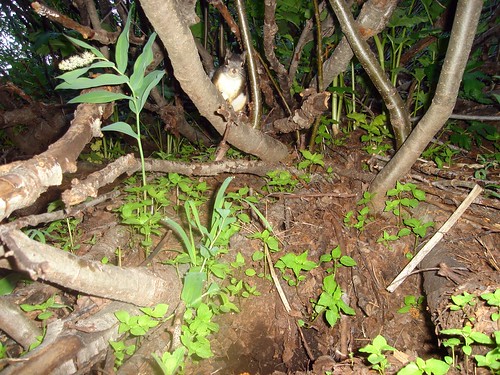
Here we will get a momentary glimpse from the forest, just below the legendary Deadman talus slope.


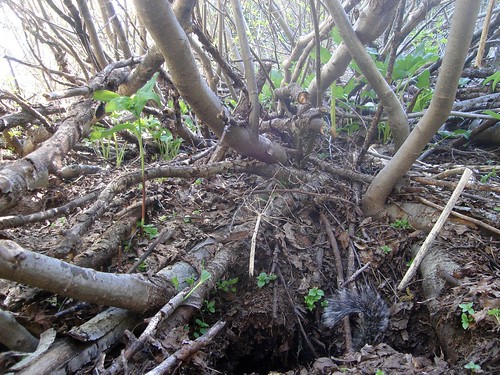
The result was our target species: a black bear came ambling through to investigate the foul smelling mess that the Codger had left 6 days earlier.


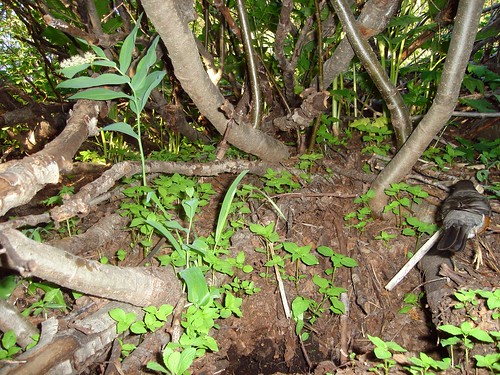
What followed was also somewhat expected, although we were hoping it would not occur...


The camera was then left pointing at the ground to fill up the SD card with glorious forest floor video.


This was my first bear on trap, and with recent news that the MARIN BEAR might be real, maybe others will soon follow...

Monday, July 1, 2013

Alert the Hipsters

WTF.

There is a wild marmot in the San Francisco neighborhood of Bernal Heights. The yuppies must be very confused. Probably hitched a ride back to town with some 30-somethings after their rock climbing adventure. Because apparently everyone is a rock climber these days.

Below is not the SF Marmot (Does it have a clever name yet, a la Sutro Sam? Has it gotten gay married yet? I hope so on both accounts), but a Marmot from when we went up to the Codger's pre-class set-up in the Sierras.

Thanks to Randomtruth for doing some excellent captaining of the car as I shot photos out of the open window.

YubaGap-7880


YubaGap-7882


YubaGap-7877


YubaGap-7883


YubaGap-7876


I used to see Marmots all the time in Yosemite Valley as a kid. We made an annual Spring Break trip to Curry Village with old family friends. It was always a great time and this old Marmot brought back some great memories.  Now we need to get him on camera trap.

Thursday, November 1, 2012

Battery Suckin' Varmits

Back to the Aplodontia set on the Yuba River this past Summer.

I mentioned that the camera only took pictures for 6 days. Well, that's what happens when you have a little rodent running in front of your camera causing the flash to go off all night long.  These guys were using the Aplodontia burrow as a highway. There was nothing left at this location by me that would have attracted mice (ie. no seeds or other food). They did seem to have some interest in the Aplodontia's hay piles.

The major culprit (I believe) was Zapus princeps pacificus (Merriam 1897).  Zapus come out of hibernation when the soil temperatures reach 8-9.5°C. These images were from late June after they had come out of hibernation and were busy putting on all the body fat they had lost over winter.
Zapus princeps most commonly occurs in mesic, montane habitats. It occupies plant communities dominated by alder (Alnus) or aspen (Populus tremuloides), stands of willow (Salix), and meadows where forbs and grasses are abundant. Typically they are found in close proximity to water in areas of dense vegetation along streams 
The above paragraph just about perfectly describes the habitat that these images were taken in. The set was in the undergrowth of an alder thicket, with nearby willows and 50m or so from an open meadow. The Mt. Beaver tunnel had standing water itself and the nearby meadow also has a stream running through it and many flooded plains.

DSC01473

DSC01475
Mid-jump!


DSC01575

DSC01495

DSC01574
Bi-colored pilage

DSC01595
Scratch, scratch, scratch

DSC01653

DSC01654
Look how long that tail is. It drags all the way to the ground.

DSC01655

DSC01657

DSC01656

The second culprit below I am a lot less sure about. It is definitely a member of the genus Peromyscus. The huge ears lead me to Peromyscus truei. It could also be P. boylii or P. maniculatus and the large ears are just a juvenile characteristic as the set was also in their range.

The tail does appear shorter than the head and body combined (strike against P. boylii). It is hard to tell because of shadows but the tail may slightly be bi-colored (P. maniculatus should have a sharply contrasting bi-colored tail), but seems to lack any tufts on the end (strikes against boylii and truei adults). P. truei juveniles have a grayer pilage which seems consistent with this individual. Hard to tell from the angles of these pictures but it appears that the hind foot is smaller than the ears (strike against P. truei) and the ears don't appear to be heavily furred (consistent with P. maniculatus). The fur is slightly darker on the dorsal side than the flanks (P. boylii might expect more distinct lateral line, but may be missing in a juvenile). There is extensive white on the belly, legs and ankles (Maybe too much for P. boylii).

So a lot of words to come to no conclusion. We need to look at its teeth and measure its hind foot, but any thoughts from the comment gallery are most welcome. Thanks to the Codger for talking me out of thinking I was sure on this ID.

Hart et al suggest that "Zapus princeps competitively excludes the deer mouse, Peromyscus maniculatus, in the field".  If is also the case that it competitively excludes all deer mice then this Zapus is not doing a very good job. Maybe the lack of exclusion has to do with the niche being a Mt. Beaver tunnel rather than a tunnel exclusive to smaller rodents.

DSC01704.crop
Cropped image. Could probably hear the campus mess hall 400m away with those ears

DSC01730.crop
Tail considerably shorter than head + body. Hard to tell if it is bi-colored or just a shadow

DSC01726.crop
Appears from this angle that the tail may be slightly bi-colored, but again may be a shadow.
DSC01701


DSC01704


DSC01726

DSC01730


Works Cited:
Hart EB, Belk MC, Jordan E, and Gonzalez MW, "Zapus princeps",  Mammalian Species 2004 749, 1-7 [Link]

Merriam CH, "Three new jumping mice (Zapus) from the northwest." Proceedings of the Biological Society of Washington 1897 11:103-104


Friday, September 28, 2012

Joining the Aplodontia Club

This post is a long time coming ...

Struck out on the elusive Mt. Beaver two years in a row and on my third season in the Sierras I finally got the little guy. Fairly decent pictures of him too, but I wish more images were in full-frame. Now that I got him I can concentrate on getting the perfect picture next year.

DSC01711
Smile for the camera!

I was so busy right after picking up this cam at the Codger's annual camera trapping workshop that I didn't get around to processing them several months later. The nice part about that though was going back through the images was almost like going through them the first time.

DSC01642
Early afternoon Mt. Beaver. Also looks like he is going through a molt. Not sure what is the new coat and what is the old coat though.
Check out that human-like ear


DSC01685
Early evening Mt. Beaver


DSC01688.crop
NOM NOM NOM.  Look at those claws!
No wonder they are able to build such elaborate tunnel systems.
Cropped image


DSC01643


DSC01687


A few more pictures, because, well why the hell not. Keep going to the bottom of the post for a short discussion on the set.

DSC01712
Great look at the ear


DSC01717
Sniff ... Sniff ... Sniff


DSC01739


DSC01742
Go! Go! Go!
A bit blurry but this guy was hauling down the tunnel right at lunch time
This set took pictures for only 6 days. A following post will discuss the flash-activating battery destroyer.

However, every photo of an Aplodontia was taken during daylight hours which is very surprising to me.  The flash still fired during many of the day photos because the camera was situated in a dense alder thicket that did not have a lot of light.

It took roughly 24 hours to get the first Mt. Beaver shot. A Mt. Beaver then visited the camera every day (+5) until the batteries died.

  • Day 2: 1:45PM and 2:31PM (considered 1 visit)
  • Day 3: 11:03AM
  • Day 4: 4:54PM, 5:16PM and 5:24PM (considered 1 visit)
  • Day 5: 6:32AM and 7:13AM (considered 1 visit)
  • Day 6: 7:11AM and 1:48PM (considered 2 visits)

I think these are likely all the same individual even though the amount of red/brown looks a bit less in some images than in others. I think that might be just an artifact of the camera, but maybe this is more than one critter.

UPDATE:  Per RT's suggestion in the comments another cropped, image.

DSC01739.crop

Monday, January 30, 2012

Beware of the Mountain Lions

We have had two different Mt. Lion warnings on the UCSC campus in the last couple of weeks.  When I got the text message for the second warning last week I decided to walk out to the area of the sighting and see if I could see myself a cat.  Alas, I was not attacked nor did I see a Mt. Lion. For that matter I could not even find any sign of Mt. Lions. No footprints, no scat.  I did not really expect to find much, but was still a bit disappointed. I have been busy finishing the last few experiments and getting figures and a manuscript ready for publication so I have not gotten outside much at all in January.  Hopefully February will be better and you will be seeing more frequent posts on CTC again.

I will have to just leave you with a couple of Mt. Lion footprints from 2011.

The first I found in the Yuba Gap placing cams ahead of the Codger's workshop.


IMG_6935.jpg


The second was found a few days later at the Chimineas Ranch while exploring a canyon with Randomtruth.


IMG_6900.jpg


Lastly an out of focus image of Mt. Lion scat. I can now proudly make bets in a bar that I could distinguish Mt. Lion poop from the other large American carnivores with my eyes closed and my nosed turned up. Just leave out the Southern 40 Miles of Arizona and New Mexico, Jaguars, Ocelots and Jaguarundis; my scent palate is not that refined yet.


IMG_6933.jpg


On another note, what is the currently excepted binomial nomenclature for the mountain lion?  I see it as both Panthera concolor and Puma concolor in fairly recent guides and sources.

Tuesday, January 3, 2012

Guest Post: March of the Marten

This is a guest post by our friend Sean P.  who joins us on many an adventure, from camera trapping the Sierras to herping and BBQing our way through the Mojave Desert. Please feel free to leave comments here and he will be sure to see them.

This is my second year being fortunate enough to work with Chris Wemmer, aka the "Camera Trap Codger." This year I was able to help set traps for his annual camera trap workshop held at the incredible SFSU Sierra Nevada Field Campus. My prime objective, the American marten (Martes americana).

I used a home-brew camera trap with a Sony Cybershot s-600 and a 'Yeti' kit. Unfortunately, when setting up, I did not think to replace the battery powering the mother board/control. Set for night shots only, I started on 7/24/2011... the battery died on 7/31/2011. Four weeks later, I retrieved the camera and realized the error.

Seven shots in eight days. Three weeks of nothing.

Disappointed but, upon return home, I discovered my luck.

First shot a blank- bummer!

Then... shots two and three- my prime objective!


.

.

.


These amazing creatures were followed with four shots of a lovely fawn.


DSC04546

DSC04548
Not bad for what could have turned out to be the camera trap blues! (Although I wish I had the other three weeks of photos...)

Saturday, September 17, 2011

Showtl Strike Two


b&A.jpg


Long, long ago we set-up some cameras for the Codger's Camera Trapping Workshop.  I wanted to try my hand at the elusive Mountain Beaver as I struck out on a couple of short sets at last year's workshop.

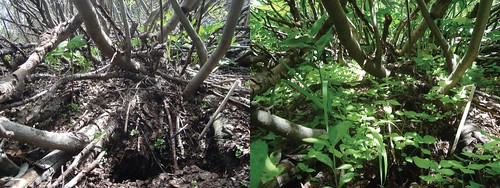
Above you can see the "Before" on 6/18 and "After" images of the set.  The picture on the left is on day 1 (6/18/11) and on the right day 26 on (7/13/11), the last day an image was taken.  As you can see there was quite a bit of growth during those 26 days.

Setting up on the entrance/exit of the Aplodontia burrow, I hoped to get, well, Aplodontia. Instead all I got was a Chickaree or The Douglas Squirrel (Tamiasciurus douglasii). But as you can see the Doug squirrel was coming in and out of the Aplodontia burrow.


DSC00335.JPG


DSC00330.JPG

DSC00318.JPG

DSC00343.JPG


The Codger has gotten a lot of different species in his magnificent Aplodontia burrow sets.  Will a Chickaree be next? I had to throw this post up in a hurry just in case it is to keep from getting scooped by ol' Codge once again.

Also got a few birds, which seemed to be about all I was getting in the early Summer. Feel free to correct my bird IDs if I have them wrong.


DSC00333.JPG
American Robin, Turdus migratorius


DSC00323.JPG
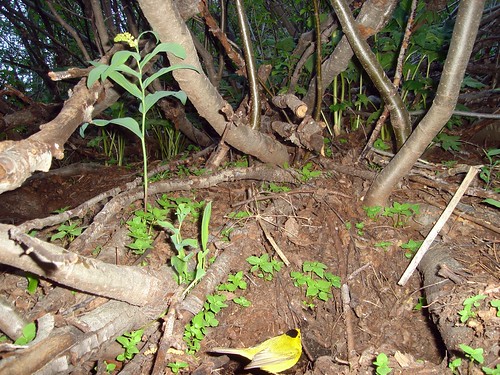
Wilson's Warbler, Wilsonia pusilla

DSC00316.JPG
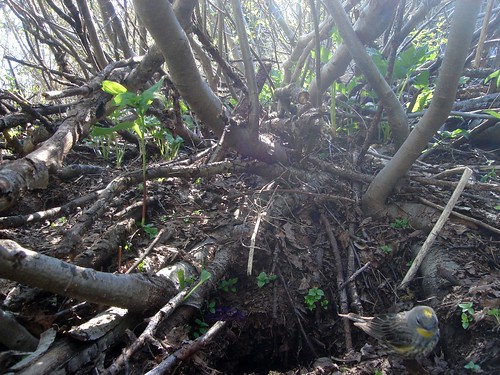
Audubon's Yellow-rumped Warbler, Dendroica coronata audubonii


I got a blurry picture of what might be a yellow warbler for the warbler trifecta, but it is not a good enough image to be sure.

Alas, no Showtls. Strike Two.  I will try again next year and hope not to strike out swinging on three pitches.

UPDATE: Changed to subspecific: Audubon's Warbler, Dendroica coronata audubonii