Title Image

Title Image

About:

This blog is predominately about camera trapping in California. We camera trap to save our souls and to teach primary school students about biology and conservation. We will also touch on other camera trapping news and musings, sets from afar, mediocre herpetology, sucky birding, and other natural history discussions.
Showing posts with label Black-tail deer. Show all posts

Tuesday, July 17, 2012

Howl Hill

Howl Hill.
Where one lets the landscape echo the primal yelp that resides within us all...

And a decent place to set a camera trap

We ascended through a patch of Doug Fir to a relatively barren, stony hilltop. The homebrew cam was locked around one particularly large boulder alongside a deer trail.
Pointing east.
I figured that this was the kids' set, so it was important to see why aiming in that direction was potentially (likely) a bad idea and I let it be.

The first results:

Fence Lizard heats up


LLAMA ATTACK*


Retrieving our first round of shots, we then reviewed the photos as a class. Were there any problems? Several students quickly pointed out the rock was in the shot and the object of focus by the camera. One student mentioned that the image was a bit bright, but others thought that it was not a big problem. We agreed to adjust the camera so that the rock was out of the shot. 


VELVETY!


1st turkey on camera trap. Worth something, I guess


Again, we reviewed the shots in the classroom and the question was presented: were there any problems with our set? A few more spoke up about the sun, which pleased me.

School was winding down at this point and for the next round, I was going to go out by myself. I switched out the homebrew for a new Bushie w/audio and flipped it 180 degrees.


My goodness.

Ten days later on the trap, we finally got a feline.


Not the Puma variety, but still very cool.
I'll be continuing to manage some cameras with Felidae over the summer and then when September comes around, the students of my new 8th grade classroom will be reintroduced to the wild...


*not a llama, obviously. durr

Tuesday, January 3, 2012

Guest Post: March of the Marten

This is a guest post by our friend Sean P.  who joins us on many an adventure, from camera trapping the Sierras to herping and BBQing our way through the Mojave Desert. Please feel free to leave comments here and he will be sure to see them.

This is my second year being fortunate enough to work with Chris Wemmer, aka the "Camera Trap Codger." This year I was able to help set traps for his annual camera trap workshop held at the incredible SFSU Sierra Nevada Field Campus. My prime objective, the American marten (Martes americana).

I used a home-brew camera trap with a Sony Cybershot s-600 and a 'Yeti' kit. Unfortunately, when setting up, I did not think to replace the battery powering the mother board/control. Set for night shots only, I started on 7/24/2011... the battery died on 7/31/2011. Four weeks later, I retrieved the camera and realized the error.

Seven shots in eight days. Three weeks of nothing.

Disappointed but, upon return home, I discovered my luck.

First shot a blank- bummer!

Then... shots two and three- my prime objective!


.

.

.


These amazing creatures were followed with four shots of a lovely fawn.


DSC04546

DSC04548
Not bad for what could have turned out to be the camera trap blues! (Although I wish I had the other three weeks of photos...)

Thursday, November 17, 2011

Keep Cruisin'

The Great Highway is still a popular route as ever at Santa Cruz's Younger Lagoon.


Munching Raccoon
Here a raccoon has made a fast food stop to chow down on a rabbit that was found as roadkill just outside the reserve.


Flighty Deer through the Fog
Go Go Go.
08:43:06

08:44:10


Chill Bobby
The highway rest stop is used for some good rubbing time and checking out the scenery during a rain storm.


Thursday, October 20, 2011

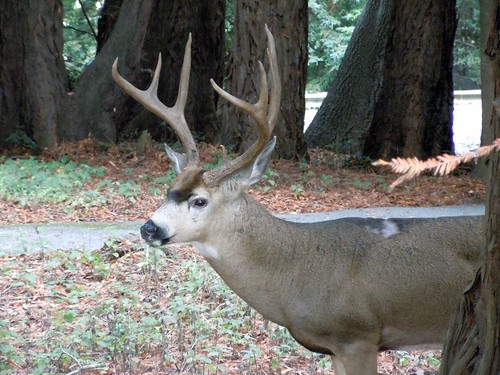
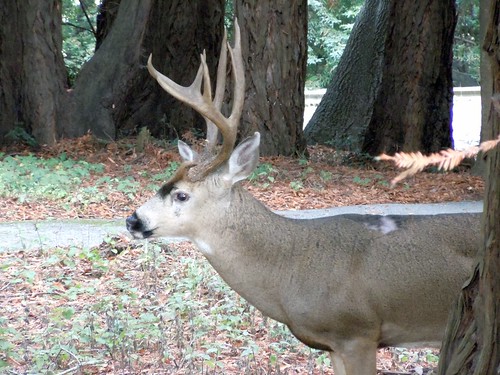
Another Big Buck

Not sure if this is the same guy I photographed two years ago (probably not), but he is a big one.  He was standing by the side of the road on campus as I was heading into lab this past Saturday, but I only got the images on my computer tonight.


DSCN0404.JPG
DSCN0402.JPG
DSCN0399.JPG

Tuesday, January 11, 2011

Bobcats Week 2

I previously posted some bobcats from the first week of a set in Santa Cruz County, CA.

The set was up for a total of 15 days and bobcats showed up during the second week too.

In two weeks we had 12 visits with 13 bobcats total.  One visit had two bobcats in the same visit.  In the 12 visits there are at least two individuals, but likely three.  I don't think there was any more than three bobcats captured at this set.  The time between visits ranged from 1.5 hours to 100 hours with a mean species visit interval of 33 hours.  I define a visit as >1 hour between images of the same species.  Visits were split roughly evenly between day and IR images.  This was a well lit set so IR correlated well with the sun being below the horizon.  Below is a graph of the visits binned into hour intervals for bobcats and coyotes for this set, with yellow being daylight hours and gray being night hours. Clicking on the graph will enlarge it.


Some data of interest for this set is as follows:
 
Data of Interest
# of pics 68
# not "test" pic 52
# of ID species 9
# of CT days 15
# of visits 26
# of misfires 5
# of test shots 16
# of triggers 52
Pos triggers 47
Pos trig % 90.4
Neg Trig % 9.6
visits/CT day 1.73
trigger/CT day 3.5
Pos trigger/day 3.1
IR images 24
Color Images 28
# of indiv 36
# of birds 15
# of mammals 32
# or small mammals 0
# of med mammals 31
# of lrg mammals 1

The number of birds, small mammals etc are the number of images not visits.  I still have to work out the complicated excel equation to get more precise visit data grouped by type of animal. Complicating the equation is if there is more than one animal in a visit, for example gangs of raccoons.  In that case, I think the total would be more informative as four "individual raccoons" rather than one "raccoon visit," but hopefully I will have that worked out shortly.

I did not ID all birds in this set hence the number of ID species being lower than it could be.  I will discuss the birds of this set once I finish IDing some of the Little Brown Birds.  With almost 2 visits a day and a positive trigger percentage over 90% I was quite please with this set despite the very heavy rain that occurred throughout most of it.  Bobcats were the most frequent visitors, followed by birds in general and then raccoons and coyotes.

The non-bird species list at this set was Bobcat, Coyote, Raccoon, BT deer and Striped Skunk.

The IR flash seems to be worse and blowout even more in wet conditions so this first photo is even worse than normal but shows two bobcats.  The previous photo in the series had the bobcat at the top of the slope in a crouched laying down position while the second one was just coming into frame at the bottom of the slope as if waiting in ambush.  I like to think it was the youngster getting ready to play attack mom.  I am going to have to do like the Codger and try and dim my IR flash a bit.  Maybe RandomTruth's upcoming post may have some more ideas on doing this.

Ambush Averted


Going on an afternoon hike

Thursday, December 9, 2010

Deer in the Brush

Three different deer showed up at the first set at YLR finishing off the three species we got at that thick willow set.  The first was a pretty looking doe.  She showed up in the early morning and spent 25 minutes around the camera showing up in 9 images.
Female Black-tail deer, Odocoileus columbianus

Female Black-tail deer, Odocoileus columbianus

Almost a week later what appeared to be a doe showed up. A little over an hour afterwards a really nice looking buck showed up coming from the direction that the doe went.  And don't snicker at this buck East Coast readers.  For a little coastal black-tail this one is damn nice.  I got four images of him in a 2 minute period.
Male Black-tail deer, Odocoileus columbianus

Friday, November 19, 2010

Bad Aim

One of the benefits of the cheaper off-the-shelf trailcams like the Scoutguard is its quick trigger speed.  The major downside is that it does not have an LCD display. You have to plug in a remote control with a postage stamp LCD screen which works fine for aiming the camera as long as you remember to bring it with you.  Alas, I forgot it when I set up this set on the UCSC Upper Campus Reserve.  I placed the camera in a thicket of brush that had a little canopy with a game trail going through it.  This lead to a well hidden camera but a very short distance between the camera and the trail.  As you can see, even though I thought I had the camera low enough on the tree it was a bit still high.  However, I was barely able to get shots of animals no more than 18" from the camera crossing directly in front of it.  Homebrews may have missed these shots.  Curve was used as scent for this set.  I don't think I will forget the LCD remote next time and hopefully get critters in frame.  FAIL

IM000027.JPG

IM000028.JPG