Title Image

Title Image

About:

This blog is predominately about camera trapping in California. We camera trap to save our souls and to teach primary school students about biology and conservation. We will also touch on other camera trapping news and musings, sets from afar, mediocre herpetology, sucky birding, and other natural history discussions.
Showing posts with label camera trap. Show all posts

Tuesday, May 8, 2018

24 hours in Pt. Reyes

I met up with Ken to head up to Pt. Reyes to meet up with some UC Berkeley folks for 1 day of adventure in and around Pt. Reyes National Seashore. We planned to do a little small mammal camera trapping, birding, herping, and mammaling(?).

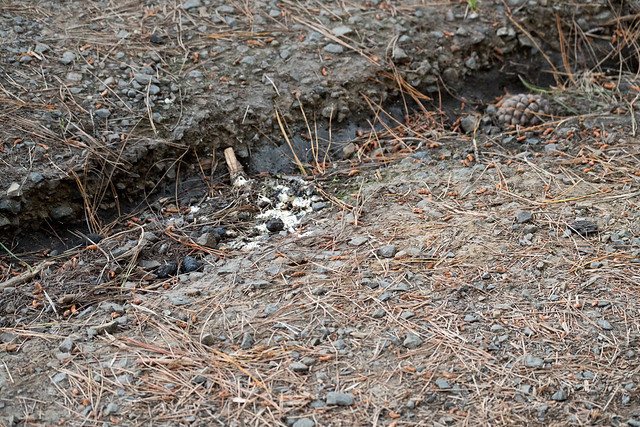
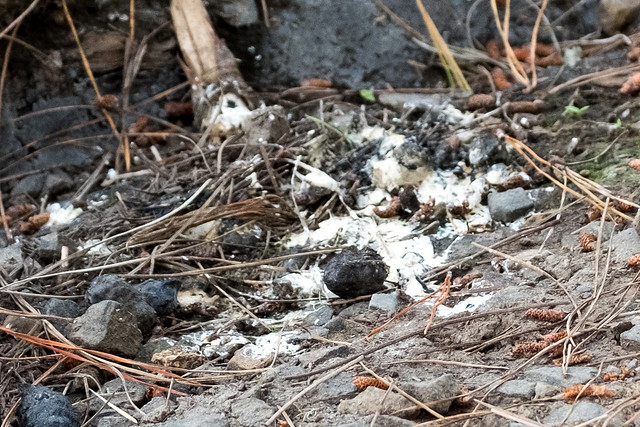
Since this is supposed to be a camera trapping blog I will start with a few pictures from an old barn where the targets were mice and small carnivores. In one night the only guy to show up was a Peromyscus maniculatus, Deer mouse. Handsome fellow. The scat on a board we found didn't seem to entice anyone.


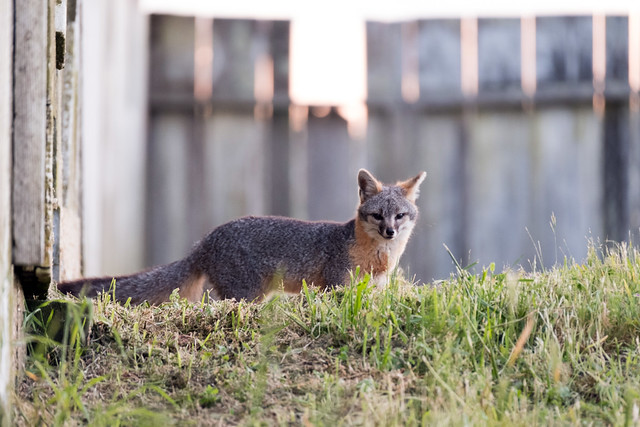
On the mammal front, on a lead from Christian (a different one) we staked out a structure within Pt. Reyes at sunset trying to grab a few pictures of a gray fox in the after sunset fading light. Considering the photography conditions I'll take this photo 8.5 times out of 10.
PtReyes-1276

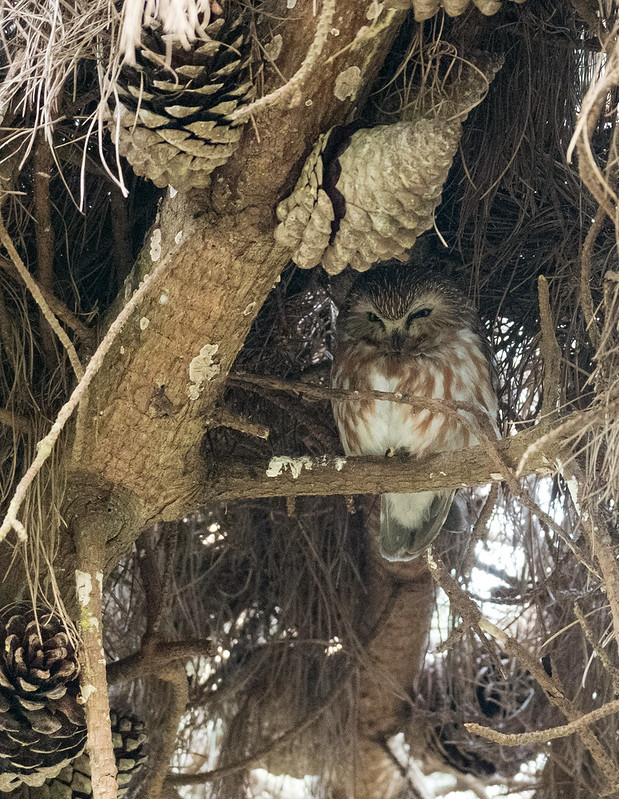
The benefit of hiking with a herper is that we are looking down a lot. It means we can miss a lot of birds because they tend to be up, but in this case it allowed us to find this little owl. I first noticed the large amount of whitewash on the trail, which made me look up into the darkness of a tree overhanging the trail and see a little ball of puff 10-12 feet off of the ground. Again the photography conditions were brutal (This was the catalyst that pushed me over the edge to buying a monopod currently in route).

!!!LIFER ALERT!!!

A Northern Saw-whet owl. If I am being honest with you, we mis-ID'ed this one in the field though. We thought it was a Pygmy Owl until looking at the photos at home (and adjusting the exposure a bit). It just seemed so small IRL. Does it still count after being misidentified in the field? We'll have to ask the birding rules committee. Either species would have been a (non-heard-only) lifer so real-time excitement was not diminished.
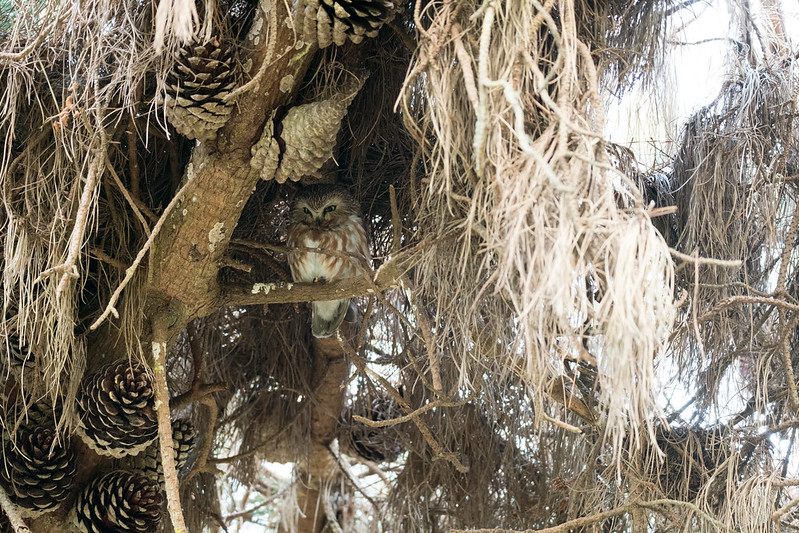
PtReyes-1253

PtReyes-1241

PtReyes-1249

Zoom in on that mess.

PtReyes-1249_crop

Don't forget to look down sometimes and then back up when you see a whitewash.

On CTC's secondary brand - the herping - it was amazing. We found ~25 snakes and I had two of the best cover boards of my life. But before those we saw a couple of Thamnophis elegans garter snakes on a short hike including one sad DOR youngster. I still don't have a macro lens for my newish camera so herp photos are limited and taken on my phone.

The first snake under a board was a 2-3' Pacific Gophersnake - Pituophis catenifer catenifer that I didn't manage to take a picture of because seconds after I lifted that board, screams from another board being lifted gave a hint to at least 8-10 Pacific Ring-necked Snakes, Diadophis punctatus amabilis. Here I hold 3 of them in my hand at once. Most were in shed, which seemed slightly curious.


Under the next board was a smorgasbord of snakes. I think we got 2 of 3 species of garter snakes but in the chaos and fleeting looks as snakes darted in every directions I can't be 100% sure.

(1) Aquatic Gartersnake -Thamnophis atratus likely integrades in Marin County.

(2) Coast Gartersnake - Thamnophis elegans terrestris. There may have been some integrades with Mountain Gartersnake - Thamnophis elegans elegans because some of the individuals we saw had a lot of blue and almost no red at all to them, but I am not really sure if that is the best field mark for determining subspecies, certainly not better than location that suggest T. e. terrestris.

(3) California Red-sided Gartersnake - Thamnophis sirtalis infernalis. I believe this is the one we dipped on, but it might have been in there as there were some snakes with a lot of blue like I said above (but not a lot of red).

Garter snake IDs were incomplete because under that same board there were better snakes to grab including several Western Yellow-bellied Racer, Coluber constrictor mormon.

But the real winner and Snake O' the Day was a male Northern Rubber Boa - Charina bottae. What a treat!


Other mammals seen were loads of Tule Elk, distant coyote, a bobcat, and several raccoons.
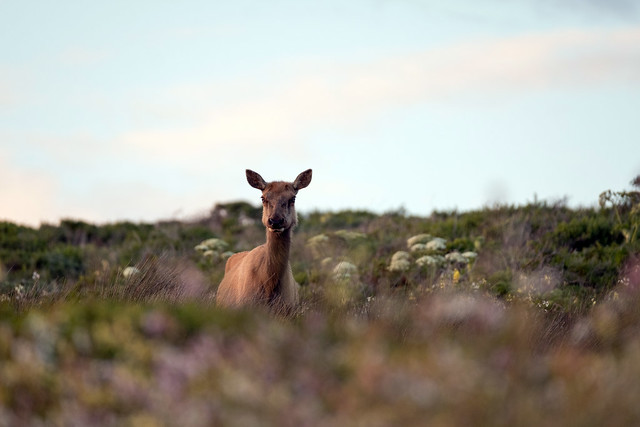
PtReyes-1257

At Bolinas Lagoon we didn't spot any otters but the Harbor seals were making noise and a Clark's Grebe was looking regal.
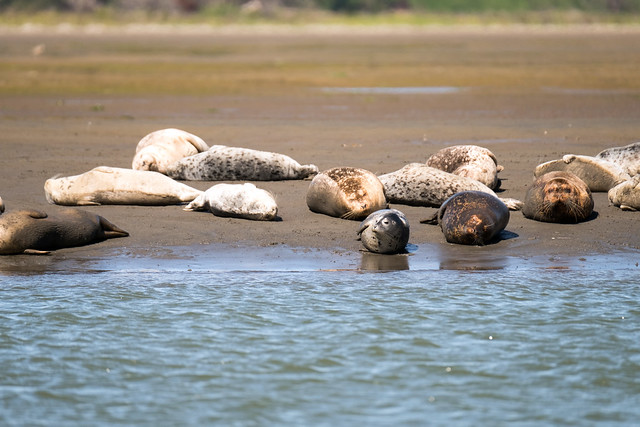
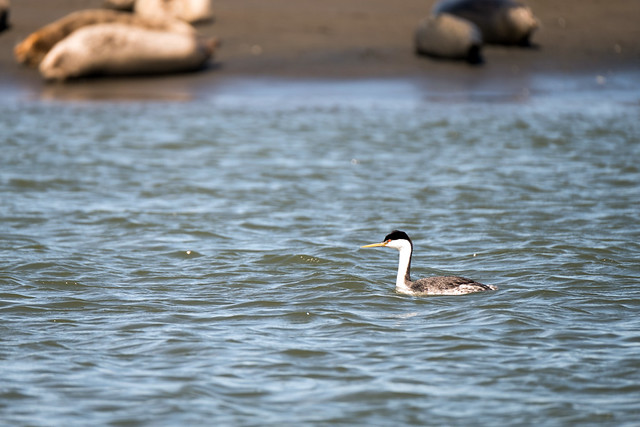
PtReyes-1297

PtReyes-1293

All in all a fantastic 24 hours in Pt. Reyes.

PtReyes-1266


Thursday, March 10, 2016

Face Off


The Hummer isn't quite in focus, but I'll take it from a camera trap.
Same spot as the glorious bathing spotted towhee
Mariposa County: April 2015

Monday, August 26, 2013

Woodpeckers doing woodpecker things

I set this first camera on a snag in the Fir forest as a pre-class set for Codger's camera trapping course v.2013. I was really hoping to get an awesome flying squirrel coming to the snag to do awesome flying squirrel things. Instead I got a woodpecker doing some woodpecker things. You know, hopping around, pecking wood, and flying. This looks like a male Black-backed Woodpecker, Picoides arcticus. Notice the yellow patch on the forehead/crown. But remember, we suck at birding, so I could be completely wrong here.


Next are some videos of White-headed woodpeckers, Picoides albolarvatus, that were coming in and out of a snag at the top of Yuba Gap on Hwy-49. We had this camera up for just a couple of hours, as it was in a highly trafficked area.


Friday, June 7, 2013

Squirrel Heaven

OK, time for an actual camera trapping post. It's been a while. Hopefully a few of you still check in on the blog.

These are some images from a set way back in Fall of 2012 and January of 2013. Yeah ... its been a while. When I first went through these images I did not ID all of the squirrels correctly. I wasn't paying enough attention and let that be a lesson to all of you out there. You might have something more interesting than you think you do.

In these two sets I got three different species of squirrel. The native Western Gray Squirrel, Sciurus griseus, and two invaders from the other side of the Rockies, the Eastern Gray (Sciurus carolinensis) and Fox (Sciurus niger) squirrels. At first I dismissed the Westerns as Easterns because of the bit of brown on the shoulders. It fooled me and Randomtruth, pointed out the error in my ways.

DSC01864
Fox Squirrel posing


DSC01846
Fox Squirrel exploring

DSC01850.crop
Western Gray Squirrel found a nut


DSC01849
Western Gray Squirrel hiding its nut

And now for something completely different ... more squirrels at an earlier set.

cropDSC01785
Western Gray


cropDSC01820
Eastern Gray with nut


cropDSC01826
Eastern Gray hiding its nut


cropDSC01829
Western Gray found the Eastern's nut? Nom Nom Nom


cropDSC01830
Maybe there is another one down there


cropDSC01831
About face


cropDSC01837
"Where the hell did my nut go? That damn local better not have stolen it!"


cropDSC01838
"Guess I'll just have to drink my sorrows away"


cropDSC01843
Glug, Glug, Glug


So thanks again to RT for point out that "There's more to your squirrels"

And two (Fox and Western) new species on camera trap for me, just by looking at my images with a better eye.

Thursday, November 1, 2012

Battery Suckin' Varmits

Back to the Aplodontia set on the Yuba River this past Summer.

I mentioned that the camera only took pictures for 6 days. Well, that's what happens when you have a little rodent running in front of your camera causing the flash to go off all night long.  These guys were using the Aplodontia burrow as a highway. There was nothing left at this location by me that would have attracted mice (ie. no seeds or other food). They did seem to have some interest in the Aplodontia's hay piles.

The major culprit (I believe) was Zapus princeps pacificus (Merriam 1897).  Zapus come out of hibernation when the soil temperatures reach 8-9.5°C. These images were from late June after they had come out of hibernation and were busy putting on all the body fat they had lost over winter.
Zapus princeps most commonly occurs in mesic, montane habitats. It occupies plant communities dominated by alder (Alnus) or aspen (Populus tremuloides), stands of willow (Salix), and meadows where forbs and grasses are abundant. Typically they are found in close proximity to water in areas of dense vegetation along streams 
The above paragraph just about perfectly describes the habitat that these images were taken in. The set was in the undergrowth of an alder thicket, with nearby willows and 50m or so from an open meadow. The Mt. Beaver tunnel had standing water itself and the nearby meadow also has a stream running through it and many flooded plains.

DSC01473

DSC01475
Mid-jump!


DSC01575

DSC01495

DSC01574
Bi-colored pilage

DSC01595
Scratch, scratch, scratch

DSC01653

DSC01654
Look how long that tail is. It drags all the way to the ground.

DSC01655

DSC01657

DSC01656

The second culprit below I am a lot less sure about. It is definitely a member of the genus Peromyscus. The huge ears lead me to Peromyscus truei. It could also be P. boylii or P. maniculatus and the large ears are just a juvenile characteristic as the set was also in their range.

The tail does appear shorter than the head and body combined (strike against P. boylii). It is hard to tell because of shadows but the tail may slightly be bi-colored (P. maniculatus should have a sharply contrasting bi-colored tail), but seems to lack any tufts on the end (strikes against boylii and truei adults). P. truei juveniles have a grayer pilage which seems consistent with this individual. Hard to tell from the angles of these pictures but it appears that the hind foot is smaller than the ears (strike against P. truei) and the ears don't appear to be heavily furred (consistent with P. maniculatus). The fur is slightly darker on the dorsal side than the flanks (P. boylii might expect more distinct lateral line, but may be missing in a juvenile). There is extensive white on the belly, legs and ankles (Maybe too much for P. boylii).

So a lot of words to come to no conclusion. We need to look at its teeth and measure its hind foot, but any thoughts from the comment gallery are most welcome. Thanks to the Codger for talking me out of thinking I was sure on this ID.

Hart et al suggest that "Zapus princeps competitively excludes the deer mouse, Peromyscus maniculatus, in the field".  If is also the case that it competitively excludes all deer mice then this Zapus is not doing a very good job. Maybe the lack of exclusion has to do with the niche being a Mt. Beaver tunnel rather than a tunnel exclusive to smaller rodents.

DSC01704.crop
Cropped image. Could probably hear the campus mess hall 400m away with those ears

DSC01730.crop
Tail considerably shorter than head + body. Hard to tell if it is bi-colored or just a shadow

DSC01726.crop
Appears from this angle that the tail may be slightly bi-colored, but again may be a shadow.
DSC01701


DSC01704


DSC01726

DSC01730


Works Cited:
Hart EB, Belk MC, Jordan E, and Gonzalez MW, "Zapus princeps",  Mammalian Species 2004 749, 1-7 [Link]

Merriam CH, "Three new jumping mice (Zapus) from the northwest." Proceedings of the Biological Society of Washington 1897 11:103-104


Friday, September 28, 2012

Joining the Aplodontia Club

This post is a long time coming ...

Struck out on the elusive Mt. Beaver two years in a row and on my third season in the Sierras I finally got the little guy. Fairly decent pictures of him too, but I wish more images were in full-frame. Now that I got him I can concentrate on getting the perfect picture next year.

DSC01711
Smile for the camera!

I was so busy right after picking up this cam at the Codger's annual camera trapping workshop that I didn't get around to processing them several months later. The nice part about that though was going back through the images was almost like going through them the first time.

DSC01642
Early afternoon Mt. Beaver. Also looks like he is going through a molt. Not sure what is the new coat and what is the old coat though.
Check out that human-like ear


DSC01685
Early evening Mt. Beaver


DSC01688.crop
NOM NOM NOM.  Look at those claws!
No wonder they are able to build such elaborate tunnel systems.
Cropped image


DSC01643


DSC01687


A few more pictures, because, well why the hell not. Keep going to the bottom of the post for a short discussion on the set.

DSC01712
Great look at the ear


DSC01717
Sniff ... Sniff ... Sniff


DSC01739


DSC01742
Go! Go! Go!
A bit blurry but this guy was hauling down the tunnel right at lunch time
This set took pictures for only 6 days. A following post will discuss the flash-activating battery destroyer.

However, every photo of an Aplodontia was taken during daylight hours which is very surprising to me.  The flash still fired during many of the day photos because the camera was situated in a dense alder thicket that did not have a lot of light.

It took roughly 24 hours to get the first Mt. Beaver shot. A Mt. Beaver then visited the camera every day (+5) until the batteries died.

  • Day 2: 1:45PM and 2:31PM (considered 1 visit)
  • Day 3: 11:03AM
  • Day 4: 4:54PM, 5:16PM and 5:24PM (considered 1 visit)
  • Day 5: 6:32AM and 7:13AM (considered 1 visit)
  • Day 6: 7:11AM and 1:48PM (considered 2 visits)

I think these are likely all the same individual even though the amount of red/brown looks a bit less in some images than in others. I think that might be just an artifact of the camera, but maybe this is more than one critter.

UPDATE:  Per RT's suggestion in the comments another cropped, image.

DSC01739.crop