For our second installment of our "Wildlife Photographer Spotlight" I would like to introduce Chris Hartzell, a very talented photographer from Monterey County. Chris and his wife Ame are a photography tour-de-force and well known in the Monterey Bay Area and beyond. Here at CTC we have been inspired by his images on numerous occasions and spent time chasing birds and flowers based on the information Chris has shared. For a more in depth bio on Chris and Ame, visit their website photostrokes.net.
On to the Q&A:
CTC: We are a little obsessed with Burrowing Owls. Christian even has a sweet
shirt with one in silhouette. If I remember right this was a burrowing
owl at the mouth of the Carmel River that you had shared on Monterey
Bird List. Christian made it down to see this owl because of your tip.
First can you tell us about framing this image. I love the way it
is hidden behind the ice plant with a "what the hell are you doing"
look on its face. Second, would you care to comment on the usefulness of
finding photography subjects via list-servs and blogs.

Chris Hartzell: This
Burrowing Owl I believe was found by Bill Hill at the Carmel River
Mouth. Bill and I have known each other for at least a decade or more
through the fire department. It was on a training incident that I
overheard him talking to someone about birds and discovered he was not
just a birder, but bird photographer and we have been fellow bird
photographers ever since. For the longest time I focused on subjects
being crisp, clear, by themselves, and out in plain sight. But it was
Bill Hill's famous Embassy Suites Peregrine Falcon shot that opened my
eyes. The image is a portrait shot of a Peregrine's face half hidden
behind one of the giant neon letters. At first glance one would say,
"but his face is cut in half". However, it has been one of his best
selling shots and I hear many comments on the capture. That
was the first moment I realized the difference between a "good" shot
and a "great" shot. A good shot shows the subject, but a great shot
tells a story. Ever since then I have looked to tell a story with my
images. In this case, I did a vertical frame to capture the foreground
of the mound and backdrop of the brush and iceplant and waited until the
owl gave me the right peek. I narrowed the F-stop to keep just the owl
in focus, but show enough of the environment. I feel it really tells a
story from the owl's perspective. Like he's sitting there all day saying
to himself, "All you walkers and joggers, passing me by all day, never
giving notice to me in my burrow". In this case, I was able to find this
owl based on the MBB listserv. I have found listservs to be a very
valuable tool in sightings. Very often paying attention to what others
see, tells me not just that a rare bird has been seen and where, but
most importantly when migration fallouts occur or
end and when it is time to hit my hotspots. When the migration starts
to hit, I focus on keeping my feeders filled more often in hopes of
attracting the rarities. So the listservs help a lot in not just my
photography, but also my birding at home too.
CTC: The
next two photos are both from the Carrizo Plains, right next to where
our mentor does a lot of his camera trapping, so our readers will be very
familiar with the area
This is one of my all time favorite
photos by any photographer. I made it down to the Carrizo Plains for
the wildflower bloom that same year, but did not get good lighting that
day, but none-the-less it was spectacular. Can you tell us about
getting this shot of such a rare California native.

CH: Years
ago I saw a photo book with an image from Carrizo Plains. It seemed
someone had spilled color all over the picture. It was by far the most
amazing wildflower shot I have ever seen, with a canyon filled from
front to back of a rainbow of colors. I found out shortly after that a
co-worker with my fire department actually lives a few miles from
Carrizo Plains National Monument and is friends with the head of staff. I
would get timely updates as to when and where the peaking of flowers
were. My wife Ame and I would spontaneously load up the gear and head
down there to capture the colors and wildlife. Believe it or not, we
have seen Kit Fox 3 of our last 4 times and photographed them twice. I
have found that Kit Fox in Carrizo are not so much rare as they are
difficult to spot. It takes a trained eye to
spot them. I've spent more than 30 years watching wildlife so I have
become trained to shapes, patterns, and colors associated with wildlife.
The first time I caught a shape off the side of the road and found a
mother with 4 pups. The second was a lone fox alongside the road that
disappeared into the brush. The most recent time was when this shot was
taken. There were two foraging in the wilting orange wildflowers and I
saw the shape of their ears as we drove past at 40mph. We stopped ahead
and carefully walked back where I was able to capture one of them
popping up to see what I was up to. Shortly after, they both slipped
into a burrow and after 45 minutes it was clear they weren't coming back
up anytime soon and we carried on. All of the fox we have seen have
been close to the road and easily visible, but only if you know what you
are looking for. In both cases, it was the ear shape that was out of
place with the surroundings that caught my
attention. The ability to pick up these out-of-place shapes and colors
is key since many species will hide if you drive slow. All but a couple
of my mammal sightings have been at higher speeds. When you hear of a
"good guide", it means they have experience in spotting as well as know
about their subjects. You cannot substitute experience in the field and
it plays a great part in wildlife photography success. The other part to
what I feel photography success should include is in-field settings.
Digital photography has taken us beyond many limits, including reality.
We can now instantly review our images, see the corrections needed, take
a thousand shots and scroll through them in minutes. But we can also
cut and paste, clone, and even turn a yellow sun red. The down side to
digital photography is you can’t always tell if the image is real. In
the old days, skill was based on one’s ability to adjust settings in the
field and then manipulate the
negatives during development. Today, skill has changed from what you do
in the field to how you can handle a computer. I emphasize in all of my
image captures, genuine in-field settings and minimal computer
manipulation. Contrast and brightness adjustments, sharpness, noise
reduction, but regardless I try and keep my post-production to 10-20% or
less. This not only produces a more truthful image, but reduces
post-production time. When you have to scroll through and edit 9,000
pictures from one trip, the last thing you want to do is spend 15
minutes per picture on major post-production. I firmly believe today
there is too much focus on spending time behind the computer and not
behind the camera. Post-production is not photographic skill, its
computer skill. All my images I focus heavily on making sure
post-production is kept to an absolute minimum.
CTC: This
is a fantastic shot too. A rarer raptor + predation shot. One of the
benefits of camera trapping is that you can often (with a bit of luck)
get some really neat behavior shots. With traditional wildlife
photography you have to be really patient to get behavior shots. Were
you watching this hawk for a while or did you stumble across it mid
lunch? You got both these shots on the same day. Was this one of your
most memorable photography days of all time?

CH: Was
it one of the most memorable photography days? Yes and no. I remember
all my days like this, especially when I have these images to reflect
on. But it was not THE most memorable as roughly over half of the time I
go out with the camera it ends up a day like this. As mentioned with
the Kit Fox, field experience is key. I was raised in the outdoors
around animals and at 10 years old my grandmother got me into birding. I
was into Biology since then and while other kids would read Moby Dick
or the Scarlett Letter, I was reading teacher's manuals on Marine
Biology or animal behavior. So I have years of experience of not just
spotting birds and animals, but also knowing where to look and what to
look for. In this case, Ferruginous Hawks are semi-common in Carrizo
that time of year. Being the largest hawk in North
America, I know their perching style is unique, especially when on the
ground. They stand upright and often look narrow with a broad chest. In
this case, I was again driving at speed and caught a different shape out
of the corner of my eye. When I slowed to look, I realized this
particular hawk's body posture was different. It was leaned forward and
feathers were flat. His tail was slightly raised and wings slightly
open. This indicated to me he was in a flight-ready mode. When I looked
closer I realized he had a kill. I pulled up and parked and proceeded to
stalk him. Stalking wildlife again takes experience. You have to
recognize when an animal is tense to your movements and when it is
relaxed. I advance slowly until I notice a change in behavior that
indicates it’s uncomfortable with me, so I freeze. I wait until it
becomes comfortable again and make another move. I do this repeatedly
until I get to a point where I notice the animal is
increasing in agitation. In this case, I got within 25 ft of him the
first time and then he flew. He landed about 100 yards away and I
stalked him again. Since I had established his comfort zone, I did my
stalking technique and stopped about 35 feet away. He became comfortable
and I was able to get multiple shots without disturbing him over about
15 minutes. The entire stalk took me about 5 minutes or less. Again,
with experience comes skill and I have many days I walk away with
numerous wildlife experiences like this in a single day. Knowledge of
your subjects is key.
CTC: Can
you tell us about getting this image? You also have one of a White
Shark, mouth wide open getting ready to hit the lure, but this shot
spoke to me a little more. It is such a beautiful, peaceful shot. I
can only imagine how awe-inspiring seeing White Sharks in the wild must
have been. Can you describe what was going through your mind during the
cage dive?

CH: This
was a very special time for me. I have been fascinated with Great White
Sharks since I was 5 or 6. By 13 I knew more about them than most
Biology teachers. By 16, my High School Marine Biology teacher actually had me
teach the portion on sharks. My biggest life dream was to dive with
Great Whites. I knew it would be a long shot since at the time Australia
was the only place with reliable White Shark diving and it would be
several thousand dollars. Then I found out they were doing White Shark
diving at the Farallon Islands off San Francisco. For a few hundred
dollars I spent 6 hours in rough cold water and a small cage puking
every 15 minutes it was so bad. But I toughed it out and ended with a
full 20 seconds of viewing a huge 17 ft 4500+ lb female make two passes
by the cage. I felt very fortunate that I was
able to fulfill such a lifelong dream. Then on the way back they played
a video of White Shark diving off Guadalupe Islands. 100+ feet of
visibility, flat 70 degree waters, and for a 5 day live aboard
excursion, was just a few thousand dollars. To make things better, it
left from San Diego which was only an 8 hour drive for me. We hadn’t
even docked the boat before I signed up for the 2004 trip. Today, I have
been shark diving with at least 11 different species of sharks in 5
countries. I have been with White Sharks 7 times now in 3 countries.
Great Whites are one of the most majestic creatures to be in the water
with. You can sense their power, but they are very wary and are quite
timid. But out of all the places, diving with the White Sharks at
Guadalupe on this trip was one of the most special memories of my life. I
had just switched to digital photography and had a “top of the line”
3mp digital point-and-shoot camera. I had purchased a
relatively cheap underwater housing when I knew I was going to be doing
the trip. The “Jaws” shot you are referring to is my signature shot I
am known for. I was actually leaning outside of the cage when this huge
14ft 2500+lb female came straight at me after the tuna head on a rope. I
kept my cool as she lunged for it with full power and when she got
within 6 ft, I fired the shot without fully viewing the display. I
ducked back inside the cage just in time to have her miss the bait and,
fully agape, rammed the cage where I had just been. My camera had
reloaded just in time for me to fire a shot of her teeth raking the
bars. When I got back on deck and checked my shot, I had captured a once
in a lifetime image. The jaws fully apart showing all her teeth and you
could see all the way down her throat. The image was so spectacular the
shark diving company purchased rights to it and there are now 3
companies using it. This moment demonstrated an
important point that I emphasize in my photo lessons…know your
equipment. I had been shooting with that camera for 3 years. There were 3
other people in the cages when she did her display and I was the only
one to get the shot. Most of the other divers on the boat had rental
camera gear or was recently purchased. None of them were familiar with
the capabilities or limitations of their equipment. In my case, I knew
exactly the zooming, framing, and shutter lag reactions and getting the
shot I wanted came instinctively rather than me having to focus on the
camera. I came away with the best shots of the group, including this
wonderful image of the sunlight piercing the surface to light up the
shark’s back. So not only was this a special trip for me as I fulfilled a
dream of not just diving with Great Whites and getting to actually
enjoy them, but I also came away with some of the most incredible shots
ever taken by anyone on those trips.
CTC: The jaws image is pretty awesome, so I am going to include it in the post.
CTC: I
really love this one. It seems almost painterly and slightly exotic.
Describe the sequence for getting this bobcat shot. Was this a
spontaneous capture?

CH: This shot was not exactly that spectacular image often thought of when viewing a professional portfolio. It was a shoot-on-the-fly circumstance. I had been shooting the beautiful sunset from our backyard and was finishing up for the evening, when our resident Bobcat happened to stroll by. He was slinking through the daisies and when he paused for a moment, I just turned the camera and fired the shot, not paying attention to settings really. Over the years I've categorized pictures into 3 types; documentation, good, and great. Documentation shots are those that are used to document or record an event or image. They are sometimes far from spectacular and could even be flat out horrible, but nonetheless a keeper for "remembering" or "recording" what you saw. I have a horrible blurry image of the shape of a falcon far in the sky in Alaska. I still keep it though as it is the only image I've ever captured of a wild Gyrfalcon...thus one of my "documentation" shots. The "good" shots are those that are too good to throw away, but not good enough to make a portfolio. In this case, the Bobcat in my backyard was a rather decent image capturing the cat in the flowers, but by no means comparative to a "great" shot. Great shots are those that are worthy of portfolio. It is important to separate out the three types of images for multiple reasons. It helps with in-field settings. If you know its a documentation shot, then it doesn't matter if you capture in jpeg vs. raw or what your ISO is at. It is for your own personal use to stimulate your memory of the event, so who cares what the settings are. When you know you are going for the good and great shots, you pay more attention to your settings. Separating them also allows for faster post-production elimination. When I have 3000 pics to go through and not much time, I pick out the obvious bad ones first, then categorize the rest into one of the three categories. When I get into a sequence of say 10 of the same thing, this categorization helps streamline the process. Good shots are those that I keep because I never quite know what I might use them for. Can you have portfolio shots also be documentation shots? Absolutely. But the idea is just because its not a fantastic image doesn't mean you always delete it. Photography is all about the feelings behind the images. Professionals translate those feelings through great images, but the average every day person will get most of their feelings from the images that inspire good thoughts and memories. This Bobcat shot in my backyard was actually a documentation shot and I like it because it reminds me of that specific Bobcat that used to come around the house all the time and the interactions that I had with it on a regular basis. The difference between this documentation shot and my more famous portfolio Bobcat shot can clearly be seen.
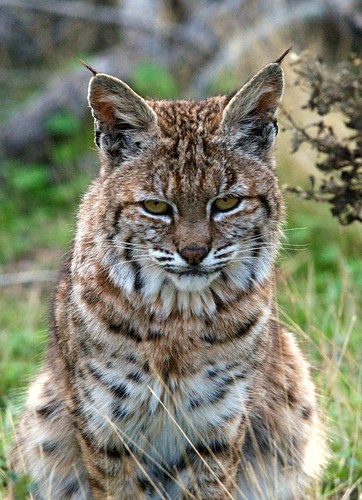
CH: This
was a case of right place at the right time. My mom was visiting and we
decided to take a walk at Monastery Beach in Carmel. We got about 50
yards down the trail when I noticed movement off the trail. A Bobcat had
been walking along in the field adjacent to us. Since this was a very
public walking place and there was a resident family of Bobcats, I knew
this one was fairly comfortable with people. Another lesson I had
learned early in my career was always carry your gear. Since I had all
my camera gear in the truck, I ran back and grabbed my 600mm lens. I
went back and started taking shots, only to find the Bobcat started
approaching too close for my lens. I had to run back and get the
100-400mm lens so I could get the shots. I walked with him for about 30
minutes when he finally paused for a bath. He had
gotten comfortable with me by now and I was able to easily approach him
within 10 feet. Generally speaking, most great shots are taken at eye
level. This not only keeps proportions correct, but also allows the
viewer to connect with the subject more emotionally. However, in this
case, I felt taking the shot at eye level would’ve had him look straight
at the camera and his eyes would’ve been more open as well as his
posture would have seen more aggressive looking. By taking the shot from
the top down, I captured a very peaceful and gentle look. I was able to
take a wild Bobcat and make the viewer feel like it was their own pet
house cat. As I said before, I feel its important to tell a story with
an image. But often to get the viewer to pay attention to the story of
the image, you have to create a connection between the viewer and the
subject.
CTC: Can
you pick one more image from your portfolio that you are proud of and
tell us a little bit about why you like the photo so much. Whether it
has a great memory, story, or composition etc.
 CH: From
a Cheetah in the Serengeti to a Red Fox in Alaska to Marine Iguanas in
the Galapagos to Great White Sharks in Mexico, I’ve travelled all over
the world and captured the most amazing images. But out of all my
images, it was a California Quail in my backyard that remains the most
poignant image of my life. Since I was 3 my mother encouraged me in
doing art. Over the years I found myself dabbling occasionally with art
of different mediums, but never taking it further than just for fun.
Eventually I found myself more skillful with the camera than the
paintbrush. But in late 2006 I joined the two into a one-of-a-kind new
art form, what I call PhotoStrokes. I used the computer mouse as a
paintbrush and digitally painted my photographs. I take the photograph,
cut out what I want to be the different layers, paint the layers, then
replace
everything. The end product has the clarity and sharpness of a
photograph, but the creativity and color of artwork. Some of my work has
only 2 layers, others many more. PhotoStrokes take me no less than 20
hours of work and can take as much as 60 hours, depending on the subject
and the end effect I want. It is truly unique and one-of-a-kind
artwork. I have not only been the first to invent it, but now in a world
where only a few others try and duplicate it, I am the only one who
provides authenticity in my work from start to finish, taking my own
photographs in the field to the end product. “Curious”, the California
Quail from my backyard, was the first PhotoStrokes I created. Since then it has expanded larger than I ever thought. In 2007 my wife and I started
PhotoStrokes.net.
Today, PhotoStrokes.net has an art gallery of our PhotoStrokes, we
offer photography lessons, do wildlife tours, help setup up overseas
tours, give equipment and travel reviews and tips, and even now do
educational and inspirational travel movies. I just completed a short
inspirational film (found here... http://www.photostrokes.net/FatcatPictures.html)
and we have plans to publish a one-of-a-kind photo book in the future
(Ame, who works as a nurse, and I a Fire Captain, work a lot though and
there isn't a release date for it yet). We are active in the
environmental community and not only work with other organizations on
some of the greatest threats to our environment, such as the Serengeti
Highway and shark finning, but also play our part as the Vice President
and Secretary of the Monterey Audubon Society. Now we do what we can to
help save the environment, educate people on photography and wildlife,
and give the world inspiring story telling images as both photographs
and unique PhotoStrokes.So although the Great White
"Jaws" shot is my signature image, it was the thrill of PhotoStroking
that Quail that started it all.
CTC: Don't forget to visit Chris and Ame's website and visit their Flickr albums for many many more great photos. CTC would like to thank Chris for his time and his thoughtful answers to our questions. Hope you guys enjoy.
You can see more at our website... http://www.photostrokes.net/index.html


