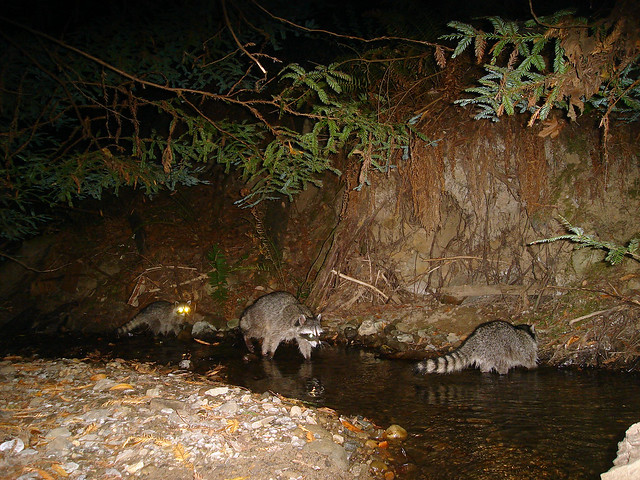
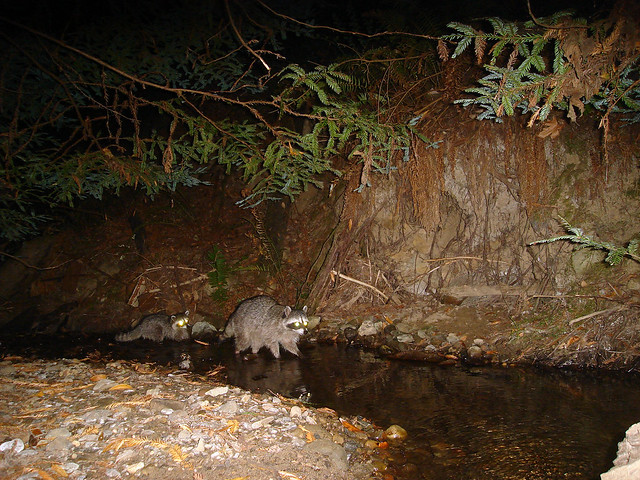
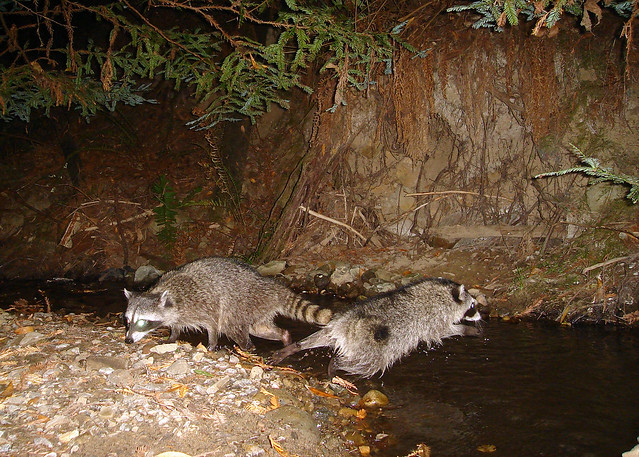
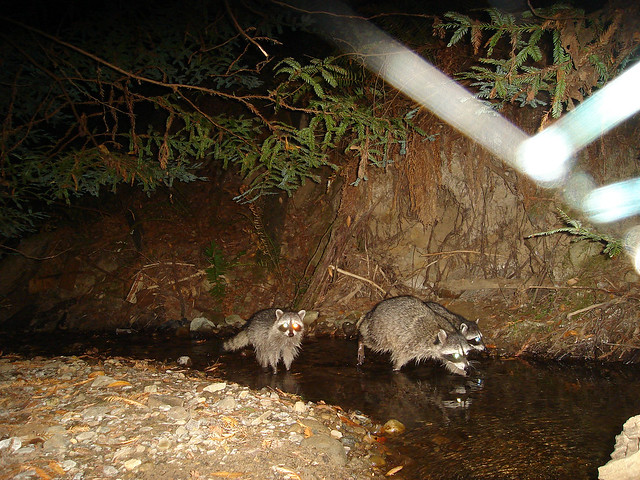
Title Image

Title Image

About:

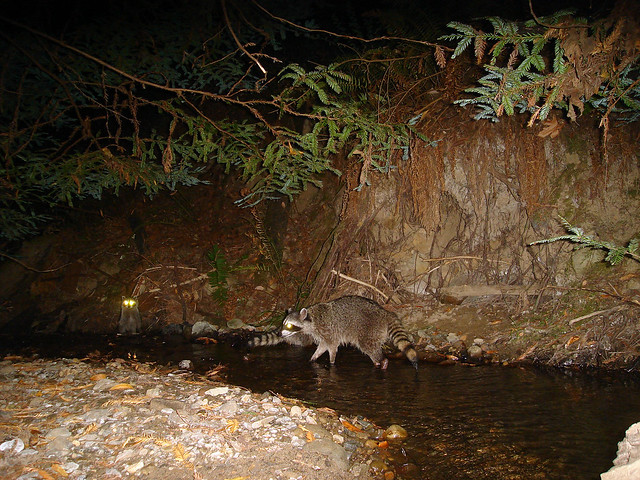
This blog is predominately about camera trapping in California. We camera trap to save our souls and to teach primary school students about biology and conservation. We will also touch on other camera trapping news and musings, sets from afar, mediocre herpetology, sucky birding, and other natural history discussions.
Showing posts with label raccoon. Show all posts

Thursday, July 27, 2017

The Return

Last summer, there were optimistic thoughts for the river otter field studies my students and I were engaged in. Our cameras had been collecting consistent solid videos each period, the students were learning signs of otter in the field and we were observing several critters during our field work, including an epic hunt of a coot.

The new school year rolled around and the pendulum swung back. Cameras malfunctioned, were swallowed up by a rising pond and with new human disturbances, the otters vanished.

Environmental Science curriculum shifted away towards studies of coho salmon and coast redwoods. The responsibilities of Adult Life also intensified and with it, camera traps began to capture nothing but dust and cobwebs.

Late in the school year, a handful of otter reports began to trickle in (PSA: please submit any observations you have to Otter Spotter !) and with the days winding down, I finally mustered up the opportunity for the class to ramble down and check things out with our own eyes.

8 months of disappointment were pushed aside as we were given another hunting performance (unsuccessful) and the scat-splattered trail gave communication that several otters were likely residing.

Cameras were deployed in two new locations, with a homebrew being used for the first time.

Hi.


noble profile w/ bud


A few other critters dropped by to check in:

young grackle being a grackle


this raccoon vibing the return of Twin Peaks

Hopefully these charismatic beasts continue to stick around for next year's students to study. 


Sunday, April 14, 2013

¡BOCA!

A constant back-and-forth that at least occurs in my head, is whether to use a homebrew hacked camera, or one of the newer Bushnell Trophys.

The homebrew provides pretty decent color images 24 hours a day. The newer Bushies, while not always in color, have options for video and the added element of SOUND. These choices of course allow for a greater opportunity to capture behavior.

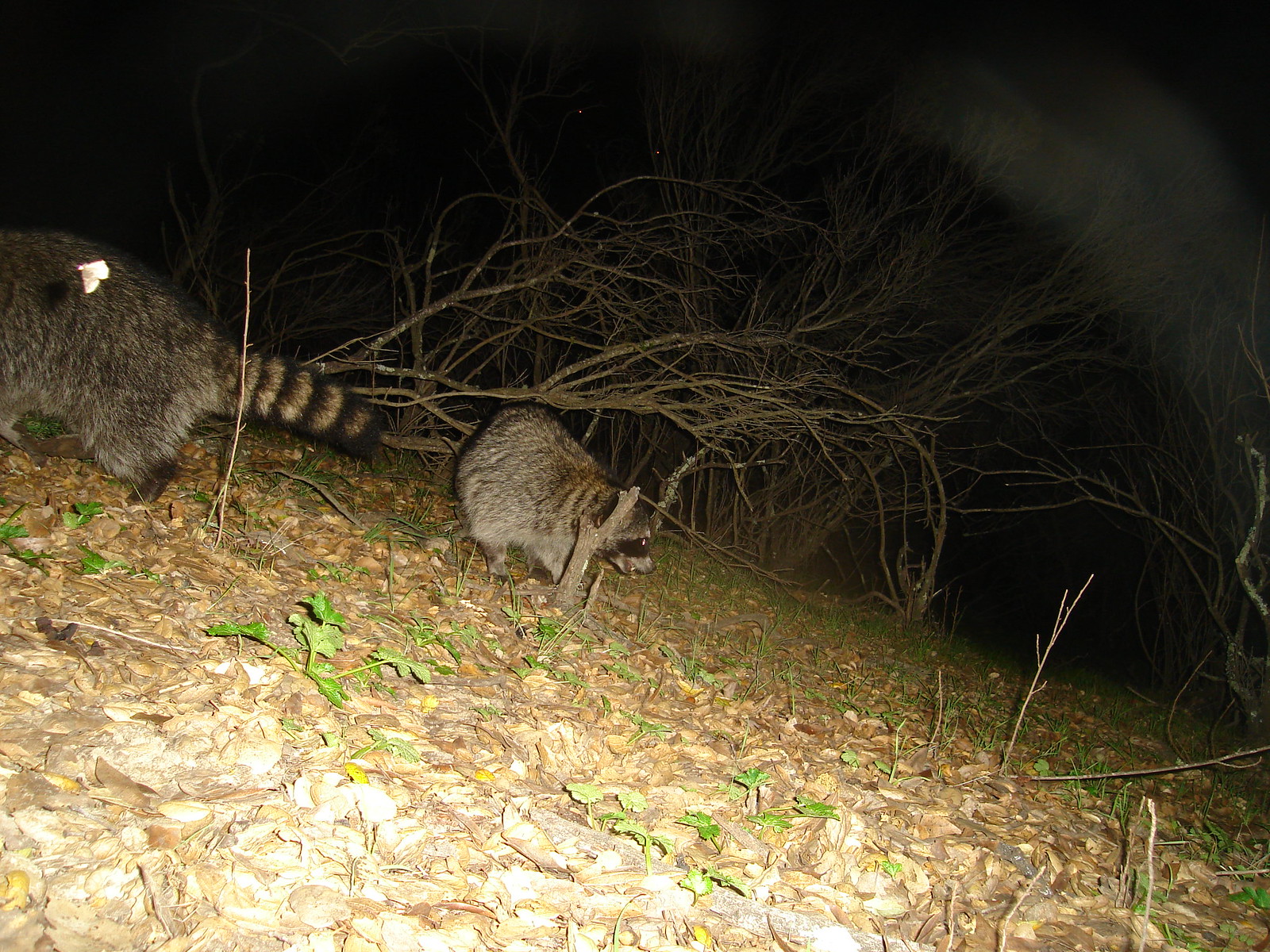
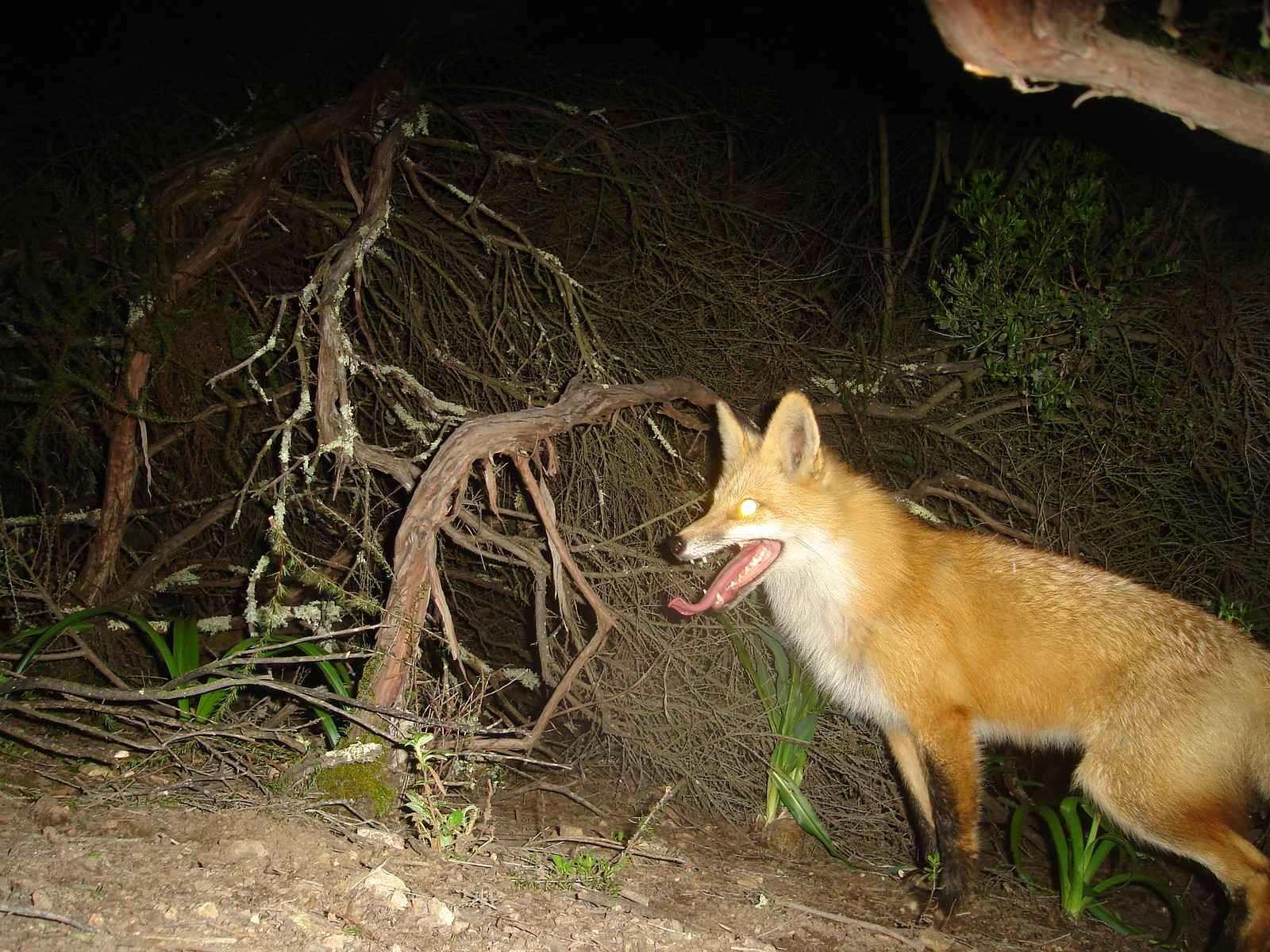
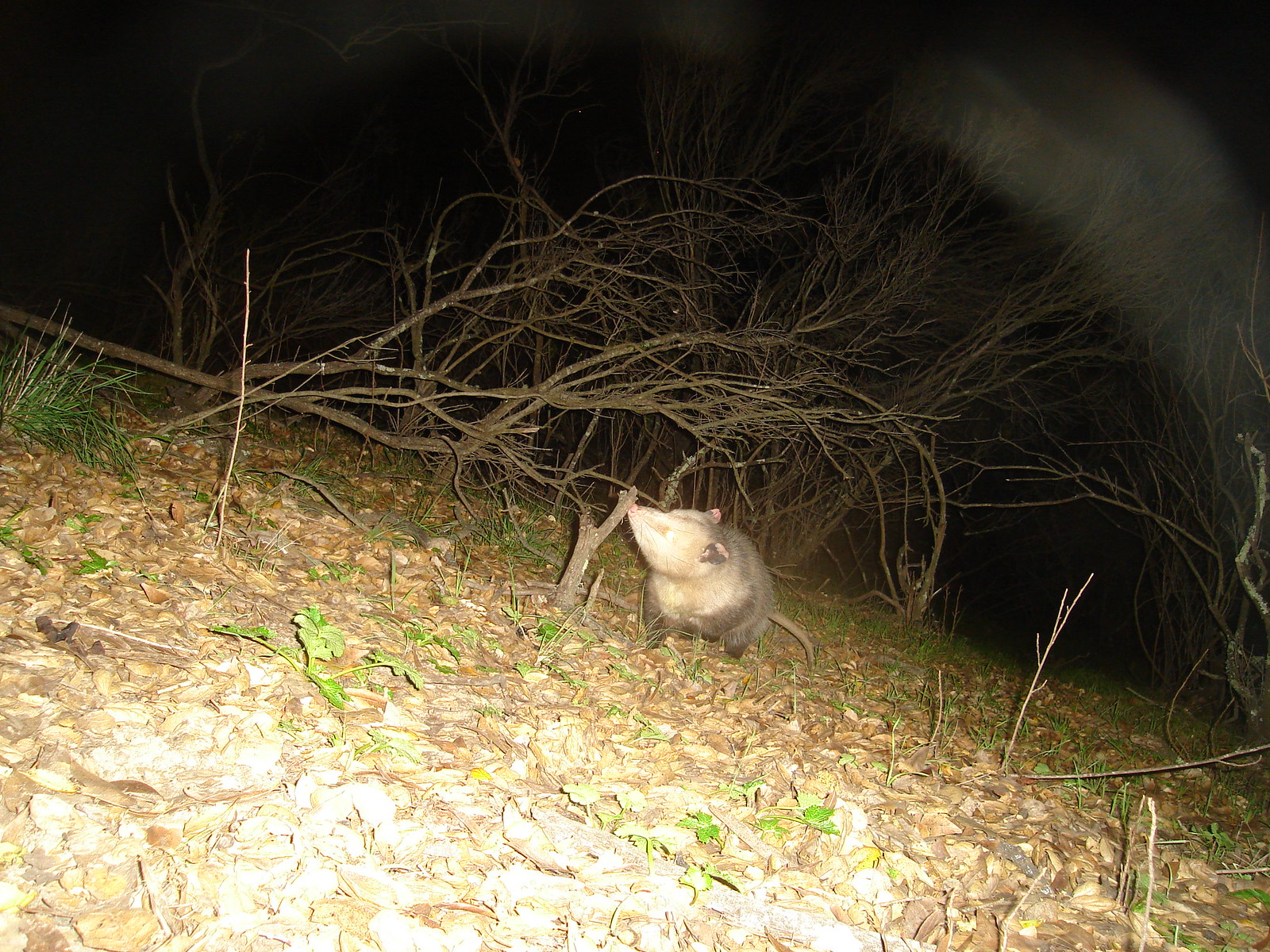
Here are a few images from Oakland's Knowland Park, where a choice for full color created questions, rather than providing additional information.


Would love to hear some crazy Raccoon sounds here. And who is #2 looking back at? What pace were they moving up the slope?


Yawn? Bark? Audition for Game of Thrones dragon role?


With a kiss. Party Opossum. Just because.


Saturday, December 22, 2012

Learning and Playing

Here are a few pictures of some raccoons, Procyon lotor, from the Santa Cruz Mountains that I got in the Fall. The main group of raccoons that came by the camera were a mother and her two offspring. They walked up and down the creek, faces up and paws dragging the bottom feeling for yummy critters to catch and eat.

DSC01800


DSC01804


DSC01811
Notice the "I am trying to concentrate" look on the young one's face.


DSC01812


DSC01814


DSC01773
Inspecting the camera


DSC01764.crop
Cannonball!!!
This is one of my favorite images of the past year


DSC01834
Just to illustrate that sometimes the 8-legged critters find your camera a wonderful place to set-up shop. This usually leads to the camera trap blues.

I know that was a lot of raccoon pictures. More than most sane people would want to look at, but these are only a fraction of the ones I could have posted.

Wednesday, June 20, 2012

Should Be Guest Post: Mother Dear [(Deer Mother) - Thinking Fellers Suburban Studies #3]

My co-teacher and amigo, Ryan, was to present this post to y'all, but after mine and JK's Mojave (mis)adventures and some dude getting baby cougs, he got a wee shy.

A story remains, however.

One of the maxims that Ryan has spread throughout our campus is BE AWARE OF THE WORLD AROUND YOU.
We apply this saying in many situations in our classroom, social thinking groups and particularly in spreading a love and enjoyment of the outdoors.

Hanging out with the family in a suburban backyard and using that awareness can lead to amazing discoveries:


Across the creek lie a fawn, curled up and waiting for mama!


Our intrepid amateur naturalist and camera trapper swiftly set up a cam to observe behavior:


 mother chases off a rascally raccoon


nursing the young


We are often merely intruders on a rich world that surrounds us. Step outside and report back what is happening in your 'hood.

Thursday, February 16, 2012

Mammalian Critters

Like I said not a great set, but pickings have been slim. That whole graduate school thing getting in the way of fun.


DSC00510.JPG

DSC00511.JPG

DSC00517.JPG

DSC00516.JPG
Woodrat using the trees branches as a highway

DSC00496.JPG
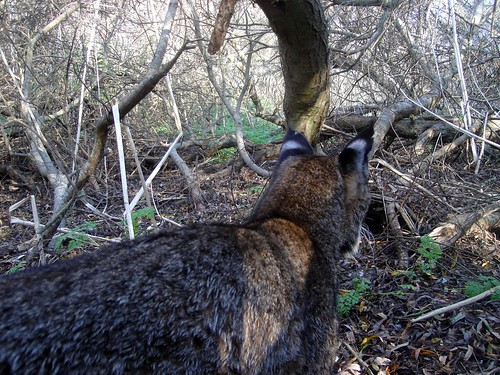
Bobcat butt

DSC00526.JPG
Bobcat Shoulder


I just cannot seem to get the bobcats to look at the camera right now.  Going to have to try a new approach.

Saturday, February 11, 2012

Sniff and Run

It has been a slow start to camera trapping in 2012 for both of us here at Camera Trapping Campus, so I thought it was time for a Sniff and Run to get back on track.

sniff and run   |snif and rən|
verb
a quick intake of something that intrigues the senses before continuing on

The first location that entered my mind for such an endeavor was Fox Nap Rock, Kent Lake. The possibilities for another set here seemed varied, interesting and guaranteed -- thus a return visit was made.
Over a span of nine days (two soaked by much needed rainfall), four species visited, with seven unique visits total.

The Participants:


Additional (Partially Obscured) non-Sniffer:


and this one just makes me laugh


The Sniff and Run did its job perfectly: providing a feeling of success along with an itch to unveil more.

As a teaser, excitement is brewing regarding planned or potential sets involving:

- urban visitor studies
- Put a Bird On It (raptor nests, Sapsuckers and the bird communities around them)
- a partnership in my classroom with Felidae Fund

Thursday, November 17, 2011

Keep Cruisin'

The Great Highway is still a popular route as ever at Santa Cruz's Younger Lagoon.


Munching Raccoon
Here a raccoon has made a fast food stop to chow down on a rabbit that was found as roadkill just outside the reserve.


Flighty Deer through the Fog
Go Go Go.
08:43:06

08:44:10


Chill Bobby
The highway rest stop is used for some good rubbing time and checking out the scenery during a rain storm.


Tuesday, November 15, 2011

Log Jammin'

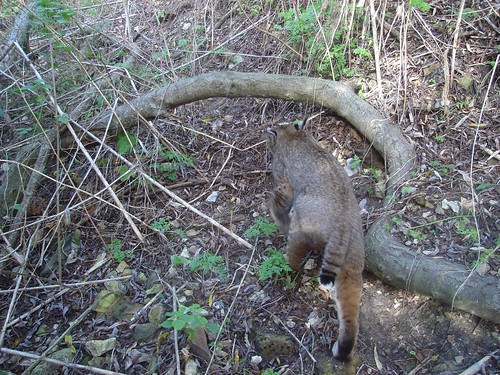
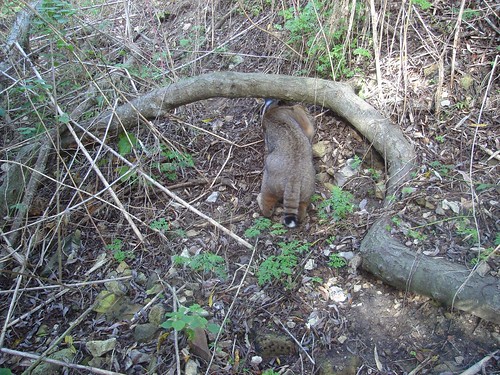
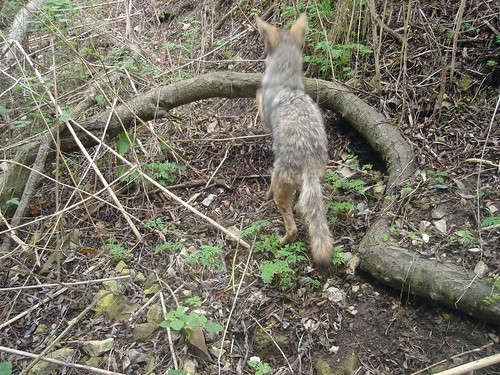
There are many ways to deal with a log in the trail. You can jam over it. You can jam under it. You can jam around it. You can even jam across it. In this set we got a few species dealing with a log in the trail in just about every way imaginable.

The bobcat goes under it. Tight fit but he just manages to squeeze through.


DSC00474.JPG


DSC00475.JPG


Don Coyote or Sancho, we still have not decided, goes over it


DSC00488.JPG


The raccoon family goes over it, across it and probably under it.


DSC00477.JPG

DSC00478.JPG


The woodrat just seems to hang out on the margins of it.


DSC00483.JPG

DSC00469.crop.jpg
Look at the length of that tail!


DSC00472.JPG


Tuesday, June 21, 2011

West Marin Roundup

Hit of Sunshine

The start of summer signals a time for camera trappers to prepare for a pilgrimage to the Sierras for a gathering of the cult of the Codger. For some it is a one time experience -- a landmark trip, yet too intense to repeat. Others return; eager to fly even higher towards the sun...

Camera Trapping Campus are these latter warriors and in order to participate in such festivities, all cams must be pulled from previous sites. What follows are the final captures from the 2010-11 season at the West Marin location.


Trail of Plenty:


gray fox sniff and run


bobcat observing


Wood Rat Midden:

gray fox deep rub

Creek:

This is a new set, for which we had high hopes. An initial placement provided a stunning background, but little showed up within the frame. After a visit in mid-April the camera was moved closer in, focusing on a log spanning the creek.


When collecting cams a month later, I arrived at the set location -- no cam. Stunned, I searched
among the duff and in the creek to no avail. It made no sense; the camera had been placed well off trail and human traffic in the area had to be close to nil due to the terrain.
Relief, however, came two weeks later when my contact at the reserve informed me that they had a cam in their office that had been collected by the sheriff after a report of "suspicious activity"* in the area.

The results from the camera were disappointing, but it felt good nonetheless to know another camera was not lost to thieves.

acceptable masked bandit


po-po cam collector


All in all, a good rookie year in West Marin. We look forward to next season with a deeper classroom experience and a focus on the small mammals that inhabit the wetter habitats.


*methinks this was the scruffy CTC crew !

Tuesday, January 11, 2011

Bobcats Week 2

I previously posted some bobcats from the first week of a set in Santa Cruz County, CA.

The set was up for a total of 15 days and bobcats showed up during the second week too.

In two weeks we had 12 visits with 13 bobcats total.  One visit had two bobcats in the same visit.  In the 12 visits there are at least two individuals, but likely three.  I don't think there was any more than three bobcats captured at this set.  The time between visits ranged from 1.5 hours to 100 hours with a mean species visit interval of 33 hours.  I define a visit as >1 hour between images of the same species.  Visits were split roughly evenly between day and IR images.  This was a well lit set so IR correlated well with the sun being below the horizon.  Below is a graph of the visits binned into hour intervals for bobcats and coyotes for this set, with yellow being daylight hours and gray being night hours. Clicking on the graph will enlarge it.


Some data of interest for this set is as follows:
 
Data of Interest
# of pics 68
# not "test" pic 52
# of ID species 9
# of CT days 15
# of visits 26
# of misfires 5
# of test shots 16
# of triggers 52
Pos triggers 47
Pos trig % 90.4
Neg Trig % 9.6
visits/CT day 1.73
trigger/CT day 3.5
Pos trigger/day 3.1
IR images 24
Color Images 28
# of indiv 36
# of birds 15
# of mammals 32
# or small mammals 0
# of med mammals 31
# of lrg mammals 1

The number of birds, small mammals etc are the number of images not visits.  I still have to work out the complicated excel equation to get more precise visit data grouped by type of animal. Complicating the equation is if there is more than one animal in a visit, for example gangs of raccoons.  In that case, I think the total would be more informative as four "individual raccoons" rather than one "raccoon visit," but hopefully I will have that worked out shortly.

I did not ID all birds in this set hence the number of ID species being lower than it could be.  I will discuss the birds of this set once I finish IDing some of the Little Brown Birds.  With almost 2 visits a day and a positive trigger percentage over 90% I was quite please with this set despite the very heavy rain that occurred throughout most of it.  Bobcats were the most frequent visitors, followed by birds in general and then raccoons and coyotes.

The non-bird species list at this set was Bobcat, Coyote, Raccoon, BT deer and Striped Skunk.

The IR flash seems to be worse and blowout even more in wet conditions so this first photo is even worse than normal but shows two bobcats.  The previous photo in the series had the bobcat at the top of the slope in a crouched laying down position while the second one was just coming into frame at the bottom of the slope as if waiting in ambush.  I like to think it was the youngster getting ready to play attack mom.  I am going to have to do like the Codger and try and dim my IR flash a bit.  Maybe RandomTruth's upcoming post may have some more ideas on doing this.

Ambush Averted


Going on an afternoon hike

Sunday, December 19, 2010

Hide yo kids, hide yo wife

And hide yo dogs and hide yo cats.  A gang of raccoons is on the loose in the East Bay with an extra strong presence in Alameda.

Raccoons appear to be getting more aggressive lately, with attacks on pets and humans on the rise. Alameda, in particular, has had an increase in raccoon attacks since the summer. 

As the City of Carmel-By-The-Sea says, raccoons have earned their bandit mask.  If you ever peruse the Carmel Pine Cone crimes report section you will quickly realize that raccoons have taken over the hamlet in gangs.

What do you get when you combine intelligence, manual dexterity, and a nocturnal lifestyle? Well, in the case of the raccoon, you have an animal well-suited to living near people. Chimneys, porches, and attics are all attractive denning sites from the raccoon perspective. Add readily accessible trash cans, or pet food and water bowls, and you've got the raccoon equivalent of a Hilton. Is it any wonder that conflicts arise between raccoons and their human neighbors? Luckily for both, a little patience and understanding can go a long way toward resolving any problems. Humane methods of conflict prevention and resolution have proven to be a less costly and less stressful than removal of a resident animal for both wildlife and homeowners. While removal may seem like a solution, it usually only creates an enticing vacancy for another animal in search of a ready-made home.

Tuesday, December 7, 2010

Nocturnal Visitors

I pulled the camera from our first set at YLR last Wednesday and finally got finished with tabulating the data and looking at the images carefully.  The last week of instruction at UCSC was stealing way more of my time than I would have liked.

Briefly, the camera was up for 14 days in a Willow thicket.  We recorded 3 species, plus an unidentified critter who barely got in the frame.  There were 9 separate visits (10 if you count two raccoons visiting the camera at the same time as separate visits) which equaled 0.66 visits/day.  The camera took 29 pictures, 26 of which had animals in them for a positive trigger rate of 89.7%  and 2.1 triggers/day or 1.9 positive triggers/day.  I will play with adding some of the this data in chart form in the future if people find it insightful at all.

Now to some pictures:

I struggled to get a good raccoon shot.  They were almost never in frame or way too close to the camera.  I even got a blurry belly shot as one raccoon came to check out the camera.  All raccoon images were in IR and they seemed to be most interested in the ground cover in front of the camera.  Raccoons visited three times and there were at least four individuals.  They visited on days 3, 11 and 12 between 23:30 and 23:55 each time (time stamp off by one hour).  The day 11 and day 12 visits were only 24 seconds off of being exactly 24 hours apart.  That masked bandit keeps a pretty regular schedule.

A Dusky-footed Woodrat was the first visitor to the camera coming by on the first night.  It reappeared on Day 2 and Day 8, when the above picture was taken.  This set was around 20 meters from the midden that I posted earlier, so maybe this rat lived there.  Of course I don't know if the three visits were the same rat or two or three different rats.  The woodrats appeared as early as 17:34 as you can see in the above image (time-stamp is off by one hour).

All images with Scoutguard SG550

Wednesday, November 17, 2010

A Midden and a Carcass

I set-up a camera this morning at the new location here in Santa Cruz.  It is a very interesting mix of habitat which should yield some good results.  Habitats includes salt marsh, riparian and chaparral.

On the hike I ran across a dusky-footed woodrat, Neotoma fuscipes, midden made of willow, cat-tail and what I think was dried hemlock stems.
I also found a dead raccoon, Procyon lotor, that was in the middle stages of decay.  Most of the fur was still left on the body, but the skull had been almost completely cleaned.  The carcass did not appear to be disturbed by scavengers.


I set the camera up about 20 meters from the dead raccoon on a game trail that looked to get moderate use.  There were also beds, probably deer, nearby along the trail and predator scat in the immediate area.  Here's hoping for some pictures of the wild cats and dogs.