Title Image

Title Image

About:

This blog is predominately about camera trapping in California. We camera trap to save our souls and to teach primary school students about biology and conservation. We will also touch on other camera trapping news and musings, sets from afar, mediocre herpetology, sucky birding, and other natural history discussions.
Showing posts with label Sierra County. Show all posts

Thursday, November 20, 2014

EXCLUSIVE: NEW GOOSE SPECIES DISCOVERED

A team of Californian naturalists has described an endangered new species of bird hidden deep within the rocky crevices of the Sierra County High Country

"northern scree goose"

Some 2 million species of plants, animals and other assorted organisms have been discovered on Earth. Perhaps millions are left to be discovered and described.

Today Camera Trapping Campus has that distinct honor.

The new species belongs to Anser, a genus of waterfowl (grey geese & some white) in the family Anatidae.

spotted !
It is a difficult-to-see creature, living mostly among the large boulders of talus slope. With its grey dominant plumage, camouflage is provided to avoid both predators from above and large ground-stalking mammals, like California's only known Wolverine.

Further studies are needed to determine feeding habits, though it is theorized that they eat lichen from the boulders. It is definitely known that they don't like lettuce.

One vocalization is known:  a low grunt, "rrrrr".

The rare goose was first spotted at 6300 feet with canine assistance, as the barking by a naturalist's dog alerted the group to scan the slope for animal presence.


fred
"these chumps are lost without me"


The recommended common name is Northern Scree Goose.


"northern scree goose !"

Friday, September 28, 2012

Joining the Aplodontia Club

This post is a long time coming ...

Struck out on the elusive Mt. Beaver two years in a row and on my third season in the Sierras I finally got the little guy. Fairly decent pictures of him too, but I wish more images were in full-frame. Now that I got him I can concentrate on getting the perfect picture next year.

DSC01711
Smile for the camera!

I was so busy right after picking up this cam at the Codger's annual camera trapping workshop that I didn't get around to processing them several months later. The nice part about that though was going back through the images was almost like going through them the first time.

DSC01642
Early afternoon Mt. Beaver. Also looks like he is going through a molt. Not sure what is the new coat and what is the old coat though.
Check out that human-like ear


DSC01685
Early evening Mt. Beaver


DSC01688.crop
NOM NOM NOM.  Look at those claws!
No wonder they are able to build such elaborate tunnel systems.
Cropped image


DSC01643


DSC01687


A few more pictures, because, well why the hell not. Keep going to the bottom of the post for a short discussion on the set.

DSC01712
Great look at the ear


DSC01717
Sniff ... Sniff ... Sniff


DSC01739


DSC01742
Go! Go! Go!
A bit blurry but this guy was hauling down the tunnel right at lunch time
This set took pictures for only 6 days. A following post will discuss the flash-activating battery destroyer.

However, every photo of an Aplodontia was taken during daylight hours which is very surprising to me.  The flash still fired during many of the day photos because the camera was situated in a dense alder thicket that did not have a lot of light.

It took roughly 24 hours to get the first Mt. Beaver shot. A Mt. Beaver then visited the camera every day (+5) until the batteries died.

  • Day 2: 1:45PM and 2:31PM (considered 1 visit)
  • Day 3: 11:03AM
  • Day 4: 4:54PM, 5:16PM and 5:24PM (considered 1 visit)
  • Day 5: 6:32AM and 7:13AM (considered 1 visit)
  • Day 6: 7:11AM and 1:48PM (considered 2 visits)

I think these are likely all the same individual even though the amount of red/brown looks a bit less in some images than in others. I think that might be just an artifact of the camera, but maybe this is more than one critter.

UPDATE:  Per RT's suggestion in the comments another cropped, image.

DSC01739.crop

Monday, October 3, 2011

Sierra Valley Foxes Continued

About a month ago I posted about some gray foxes in the Sierra Valley.  We got pretty good shots of mom and pup.  Well, I had also set an IR camera up on video at the same set, that I only now downloaded.  I had forgotten it was set to video and thought it was on still image so I was not all that excited about looking at IR stills when I had the nice color homebrew pics.  See I have a ScoutGuard model that has the programmer and image viewer on a remote control.  I don't have a clue where my remote control is, hence how I did not know whether it was set to video or still.

So I was pleasantly surprised when I downloaded the files and realized they were videos.

But first a still shot from the next morning to set the scene a bit in your mind while you watch the videos.


These first couple of videos do a great job of showing just how little the gray foxes care about the homebrew white-flash.  The homebrew gives a couple of early flashes (red-eye reduction mode) and then gives the big flash and takes the image.


I thought we had a mom and her pup. But in this video (88) it appears there are three maybe four individuals.  You never see more than two at a time, but unless exits the scene at the bottom one circles back around and re-enters the scene from the top in a matter of seconds mom may have had more than one pup.


In this video one fox finds the camera and moves it around a bit.


Saturday, September 17, 2011

Showtl Strike Two


b&A.jpg


Long, long ago we set-up some cameras for the Codger's Camera Trapping Workshop.  I wanted to try my hand at the elusive Mountain Beaver as I struck out on a couple of short sets at last year's workshop.

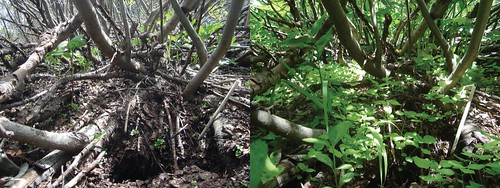
Above you can see the "Before" on 6/18 and "After" images of the set.  The picture on the left is on day 1 (6/18/11) and on the right day 26 on (7/13/11), the last day an image was taken.  As you can see there was quite a bit of growth during those 26 days.

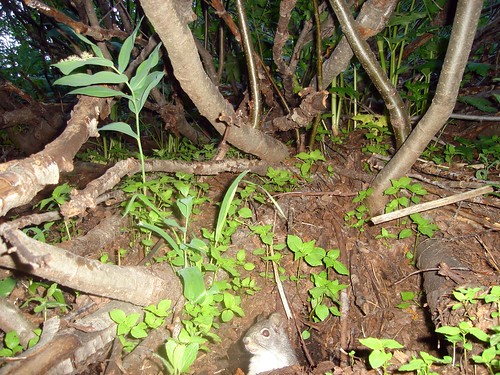
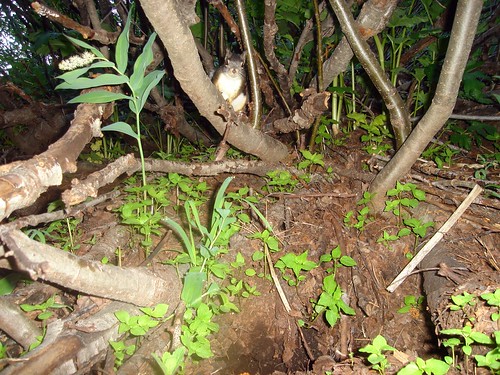
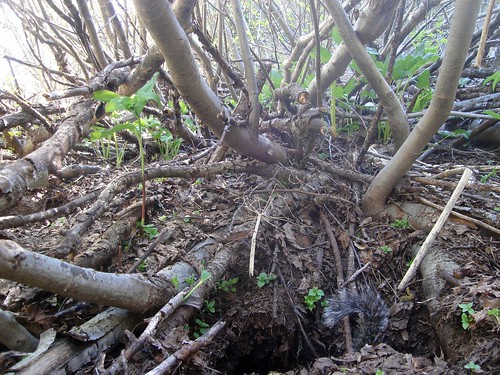
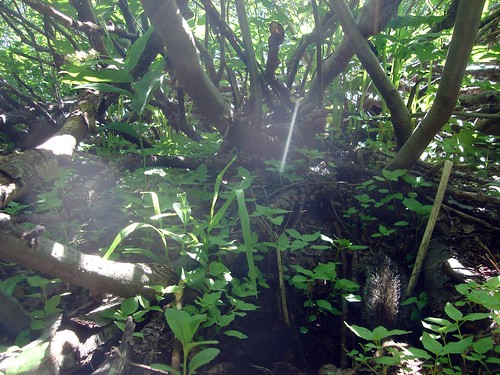
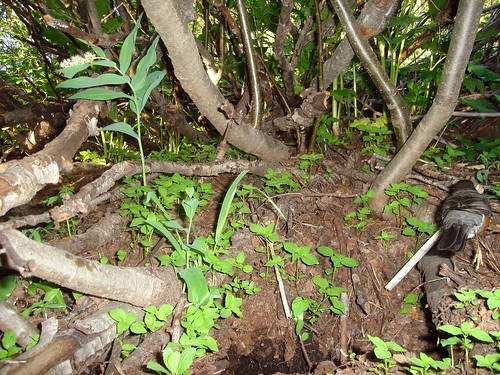
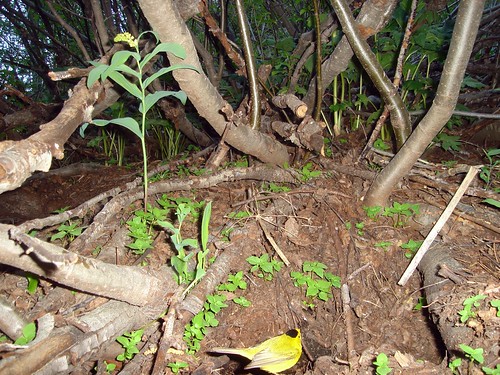
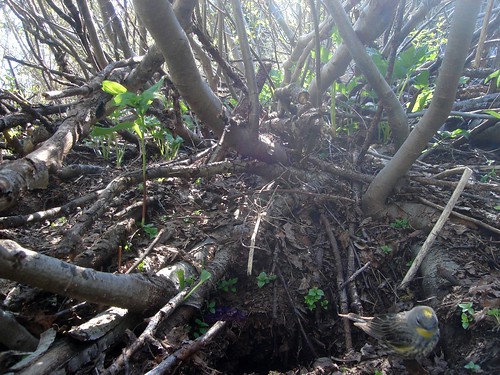
Setting up on the entrance/exit of the Aplodontia burrow, I hoped to get, well, Aplodontia. Instead all I got was a Chickaree or The Douglas Squirrel (Tamiasciurus douglasii). But as you can see the Doug squirrel was coming in and out of the Aplodontia burrow.


DSC00335.JPG


DSC00330.JPG

DSC00318.JPG

DSC00343.JPG


The Codger has gotten a lot of different species in his magnificent Aplodontia burrow sets.  Will a Chickaree be next? I had to throw this post up in a hurry just in case it is to keep from getting scooped by ol' Codge once again.

Also got a few birds, which seemed to be about all I was getting in the early Summer. Feel free to correct my bird IDs if I have them wrong.


DSC00333.JPG
American Robin, Turdus migratorius


DSC00323.JPG
Wilson's Warbler, Wilsonia pusilla

DSC00316.JPG
Audubon's Yellow-rumped Warbler, Dendroica coronata audubonii


I got a blurry picture of what might be a yellow warbler for the warbler trifecta, but it is not a good enough image to be sure.

Alas, no Showtls. Strike Two.  I will try again next year and hope not to strike out swinging on three pitches.

UPDATE: Changed to subspecific: Audubon's Warbler, Dendroica coronata audubonii

Friday, September 2, 2011

Sierra Valley Foxes

As the Codger alluded to, we picked up some cameras in the High Sierras a little while back.  I also did a short set at a cabin I was staying at in Sierra Valley.  First, because this blog is in desperate need of some camera trapped mammals before we get back to the birds I present two, one-night sets.

The first night I put up my camera on a rock 10 feet or so from the rock we (CTC, The Codger, Randomtruth and SPP) used to get the brother fox visitor that was so interested in the Mr. Screechy doll back in June.

Right on cue, we got a fox visitor in five images. 2 for 2 for foxes in this locale. Randomtruth and I discussed the fact that the property must be on the regular nightly loop for this fox.


Only later did I realize that there were two foxes in this image.


The next day I was wandering around the property looking at the Native American acorn grinding pestles (I gotta start taking handheld shots for these posts) in the granite rocks when I started to notice a lot of fox scat. I mean A LOT.  Hundreds of them. Around the base of a rock outcropping.  In between the rocks. Everywhere.  Some old. Some attracting flies.  I figured that the foxes might be living in the dark recesses of these rocks mere feet from the campfire ring. The property may not just be on the nightly loop, but it appeared that it was on the daily hide-spot circuit too.

I soon found a rabbit foot.  Then a squirrel haunch. Then a bird wing. A wing that may or may not have been a chicken. Boggis, Bunce and Bean are not happy.

So I reset on this outcropping hoping that I would get them again, this time with both foxes in full frame.


3 for 3.


Not sure if this is a mated pair of foxes or Mrs. Fox, that sexy vixen, and her older pup.  One of them seems to have those fluffy paws that are a touch too big for their body, making me lean towards mom and pup.

This potential pup looks more Ash than Kristofferson Silverfox though.


I always enjoy the out of focus nose right in the camera image.


Are either of these foxes the same brother fox from two months ago?

One of them found the stick dipped in Predator 700 lure.  Carried it to lower ground and licked it and moved it again. Or maybe ate it as the stick disappears in the next image. Yum. Notice the not-so-fluffy paws.


The eye shine is pretty rough in some of these images, but I am not really sure there is any good way to reduce it, other than post-processing which I was not able to do without the eyes looking fake.  No perfect picture in the bunch but a good number of decent ones.

We will see if we can make it 4 for 4 the next time we are up in the area.

I will delay the traditional (if 5 weeks is a tradition) Friday Link Dump until Monday to keep from stepping on a busy week of posting by CTC standards.  Hopefully the Codger doesn't steal too many of our links. :)

Sunday, June 26, 2011

Screechy in the High Country

Last summer, the call of the Sierras introduced Camera Trapping Campus to the wild, delirious world of camera trapping.

Less than a year later, we return early: slightly craftier and eager for challenges.

Assembling with a crew consisting of the Codger, Random Truth and a few other chums, we set up cams for the Codger's workshop.

A great time was had exploring new habitats and placing some cams in locations that had intrigued us the year before, but were unfortunately passed over due to time limitations.

After a hard day's work, the crew settled in for the night at an agreeable, cozy cabin. A hearty feast was prepared to fill our empty stomachs while stories and schemes were passed between the merry group. Codger and Random Truth were fresh off two successes with "Hornly", a plastic Great Horned Owl that attracted swift attention from the real deal.

Thus, it was decided that we must continue the experiment, this time with a homemade Screech Owl decoy placed in the backyard of our cabin. 3 hours of Western Screech Owl calls were loaded onto Random Truth's Ipod and the decoy was deployed at 9:00pm, with three cameras focused on the furry fake -- two homebrew cams courtesy of Random Truth and Sean P. respectively, and a Bushnell Trophy Cam set for video by yours truly.

set view w/ homebrew 1 and video Bushie

shot of Screechy from homebrew 1

The calls pierced through the mute night, providing a soundtrack for our after dinner beers. Minutes after midnight, the Ipod had done its work and shut down. We had not observed flashes from the homebrews, but regardless hoped for the best and retired to bed.

A morning check-in provided us with success, but not one we were expecting:

1:35 am visit


1:35 am visit

Brother Fox visited again 1 hr 50 minutes later.

3:22 am visit

3:22 am visit

Did the call of "Screechy" bring in our Fox friend? Unlikely, for the delectable smells of our feast (bacon-wrapped meatloaf) and an additional treat left in a nearby rock crevice (roadkill squirrel) would have provided a far greater and expected attractant.