Title Image

Title Image

About:

This blog is predominately about camera trapping in California. We camera trap to save our souls and to teach primary school students about biology and conservation. We will also touch on other camera trapping news and musings, sets from afar, mediocre herpetology, sucky birding, and other natural history discussions.

Friday, August 26, 2011

Link Dump

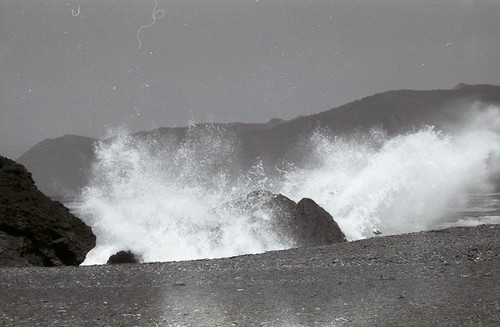
Black Sand Beach
Lost Coast. Photo by Christian


A new species of bird discovered as a museum specimen by Peter Pyle of Devil's Teeth fame.

Will the Tea Party fight the protection of the Eastern Diamondback Rattlesnake that adorns their adopted flag?

A sea lion found on the Santa Cruz Pier with gunshot wounds is recovering at the Marine Mammal Center in Marin. UPDATE: Bad news. The sea lion was euthanized.

As the Codger promised we will have a couple of posts from the High Sierras coming in soon.

Needed steroids to beat the ol' Oak and I am finally starting to win.  No more coastal camera trapping in shorts.  Yes, yes I knew better, but it was such a glorious day and we may have not been in our right mind after a day of beer brewing the day before.

Speaking of beer, check out my friend Kate's beer blog, Brew in Review.  She drinks beer, visits breweries, and brews her own beer.  She is also a herper.  Sorry guys but John already put a ring on it.

Friday, August 19, 2011

Link Dump

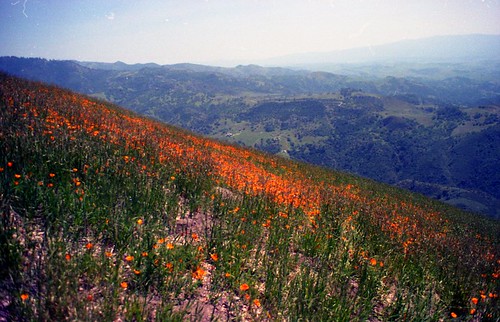
CA Poppies

CA Poppies


Bad news for the Mountain Yellow-legged Frog.

IR camera trap images from the tropics.

Viviparous dinosaurs (Plesiosaurs)

Good news for the Lake Erie Water Snake.

Bird Evolution may have begun with the legs rather than the wings.  Also of interest, this seems to suggest that reptiles may have been warm-blooded and lost this feature as a common ancestor of reptiles and birds had and lost a protein used in endothermic metabolism.

Who lost their capybara?  I have always dreamed of owning one to live in a little pond in my backyard. Paris Hilton better not get one before me.

Clapper Rails nesting in SF.

Living with coyotes workshop in SF.

Also, poison oak sucks.

Wednesday, August 17, 2011

Beach Trapping Part II

Bringing you Part II of the beach set.  Again, I am leaving out a good chunk of images of researchers including some good action shots of what appears to be pitfall trap building. We did not get any new mammal species but got some fun new birds.

First up is another killdeer, this one looks like a juvenile under stormy skies.  Can you even find it in the image? Killdeer reside in Santa Cruz County year round.

Young killdeer

This time a bobcat actually looks in the direction of the camera instead just giving us a look at its tail.  Still not the glamor shot I am aiming for though.  I need it to get closer to the camera as the little dune is hiding the full animal a bit.

Bobcat

This was just going to be a stormy sky shot but then I found the little bird that set off the camera.
Stormy skies

Killdeer

A couple of Canada Geese in the background.  Bummed to have missed the Cackling Goose that was hanging out with these two for a couple of weeks.  In the fore-front is a Whimbrel, Numenius phaeopus.  The Wimbrel is one of the most common of the curlews and migrates through the Monterey Bay Area as well as resides here.  Be sure to check the link for some ebird.org data. The Whimbrel only showed up on the camera one day, but there is a pretty steady stream of sighting at YLR with a slight peak in April when these pictures were captured.
Canada geese with Whimbrel


Three Whimbrel


A young killdeer standing atop the dead seagull.
Young killdeer standing on dead gull
And finally a sunrise image of some Brewer's blackbirds, Euphagus cyanocephalus.
Brewer's Blackbirds

Friday, August 12, 2011

Camera Trapping on the Beach

I made this set back in the Spring on the beach dunes pointing North away from the Ocean.  Yes I said North.  In most of Santa Cruz County the ocean, more properly Monterey Bay is South rather than West.  Believe me it is quite confusing to the internal compass.  I have to constantly remind myself, so that is South not West.  I happened to find a freshly dead seagull and moved it a few feet in front of the camera to see if something would come by and dine on it.  There were bobcat prints around the seagull, so I was obviously hoping I had scared it off and it would be back.

View of the set, looking into the beach dunes
The first things to come by were about 90 images of a field biology class.  I did not want to go through the trouble of getting their permission to post their images so you will have to take me at my word.

Next was a bobcat that came by during the night and sniffed around for a minute or two.  Unfortunately all I got were butt shots as it placed itself between the camera and the dead bird. This is not either mum or kit that we have seen so often before.


The bobcat did nothing more than sniff.  I guess it was not hungry enough to eat a three day dead bird.  Or maybe they don't care for greasy seagulls.
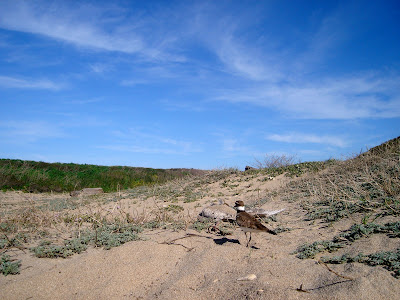
Charadrius vociferus
A killdeer checking the area out.  These may have one of the better latin names in all of the bird world. Charadrius vociferus. Vociferus indeed.


A ground squirrel.  Gotta say his real estate is much better than all the ground squirrels we see in the meadows of campus.  I am sure he has a bit of a collapsing tunnel issue though.

A raccoon stops by in the rain.

Spermophilus beecheyi
Beecheyi on guard once again.

Batteries only lasted 6 days due to the large number of human triggers and yielded mostly butt shots, but the killdeer and ground squirrel were new photographed species.

I reset the batteries and gave it another shot with only slightly better results that I will share next time.