Title Image

Title Image

About:

This blog is predominately about camera trapping in California. We camera trap to save our souls and to teach primary school students about biology and conservation. We will also touch on other camera trapping news and musings, sets from afar, mediocre herpetology, sucky birding, and other natural history discussions.

Sunday, July 15, 2012

Felidae Adventures: Training Days


This spring, my 6th / 7th grade class met up with the Felidae Fund for the start of what is hopefully a long-running relationship with my classes.

First, the Felidae team came into the classroom to present a Mountain Lion power point lecture. It was pretty much the presentation that they give out on the road to adult audiences and a credit must go to them for putting together a presentation that could hold the attention of an audience spectrum ranging from highly educated adults to early teens with learning difficulties.

The class was completely transfixed by the photos and information and could not wait for their second visit into the classroom: a lab activity demonstrating the effect of development on Mountain Lion populations, and then in turn, deer populations.

After the lab came the waiting game -- when would we be able to go out into the field and hopefully find one of these majestic creatures with camera traps?

Several rounds of practice sets around campus and Lucas Valley familiarized the students for many aspects of the camera trapping experience: looking for signs of animal presence, angles to use to best capture the animal's path and what to use in the environment for camera placement.

The time came in mid-May for the big league call-up, with us meeting the Felidae crew at the Mt. Tam watershed. The goal was to set up at least three cameras in two separate pre-planned locations. On the hike to location one, a dry gully, we observed fresh bobcat scat. With the fortuitous poop discovery, we merrily continued to the gully and set up two cameras, one video, one still.

preparing camera uno
The gully sets produced many deer shots over a seven week period, along with the occasional raccoon. Nothing spectacular, or exhibiting interesting behavior, so I am not going to post them.

Upon completing camera setup, we marched up what was to be known as Howl Hill...


What dangers would we encounter?
Would an animal other than a deer wander past our camera?
These questions and more answered in the next post !

Wednesday, June 20, 2012

Should Be Guest Post: Mother Dear [(Deer Mother) - Thinking Fellers Suburban Studies #3]

My co-teacher and amigo, Ryan, was to present this post to y'all, but after mine and JK's Mojave (mis)adventures and some dude getting baby cougs, he got a wee shy.

A story remains, however.

One of the maxims that Ryan has spread throughout our campus is BE AWARE OF THE WORLD AROUND YOU.
We apply this saying in many situations in our classroom, social thinking groups and particularly in spreading a love and enjoyment of the outdoors.

Hanging out with the family in a suburban backyard and using that awareness can lead to amazing discoveries:


Across the creek lie a fawn, curled up and waiting for mama!


Our intrepid amateur naturalist and camera trapper swiftly set up a cam to observe behavior:


 mother chases off a rascally raccoon


nursing the young


We are often merely intruders on a rich world that surrounds us. Step outside and report back what is happening in your 'hood.

Tuesday, June 12, 2012

We Suck at Birding

I gotta admit we suck at birding.  We spent a day arguing over a bird and trying to chase it down only to realize that it was two different birds and we were talking past each other the whole time. Maybe Mojave 2013 will require the presence of a real-life birder.

MacGillivray's Warbler, one of the birds in question

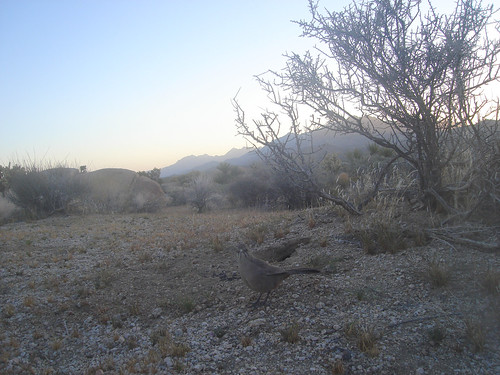
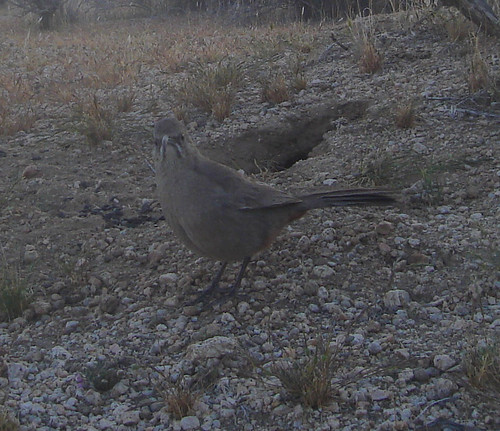
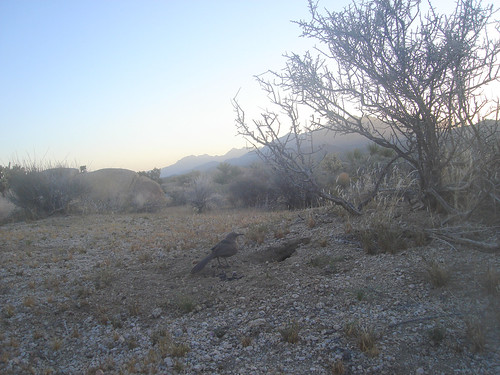
A couple of shots of a likely Crissal's Thrasher from a camera trap that was supposed to get ground squirrels, but only got this dang sunrise bird.


1-DSC00567
What's up?


Crissal's Thrasher?
Crop of above image: what looks like a light iris, white mustache, slightly more gray than brown.

2-DSC00568
Beauty of a morning

Thanks to Seagull Steve for suggesting the possibility of Crissal's, rather than LeConte's, but in no way hold him accountable if this is not a Crissal's. I sent him low-resolution images when getting his opinion and neglected to resend high-resolution images.

Occasionally, we were able to identify a few feathered friends.

Red-tailed Hawk in nest.

And yet there were still questions…


Gray Flycatcher? Migrating Hammond's? UPDATE: Or Neither Townsend's Solitaire

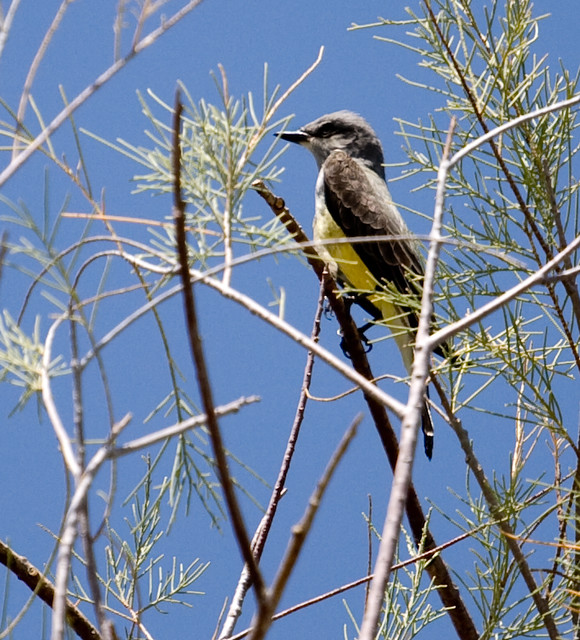
Cassin's or Western Kingbird. F! Update: Western it is

Because we suck at birding feel free to correct our IDs if needed. Birding by photography can be tough because you often don't have all the angles necessary to make a good ID later.

UPDATE: Some IDs fixed thanks to Seagull Steve in the comments


Friday, June 8, 2012

Friday Coyote Blogging

Bolinas Ridge 6.7.12

Tuesday, June 5, 2012

Squirrel Butt

This is not a great capture but it is the only one I got of a new to us camera-trapped species. We were hoping for more interesting Ground Squirrels like the Mohave ground squirrel, Xerospermophilus mohavensis, or Round-tailed ground squirrels, Spermophilus tereticaudus, but all we got was this White-tailed antelope ground squirrel, Ammospermophilus leucurus.

If you are really into ground squirrels at least you can take solace in the fact that he is showing off his money maker.


1-DSC01441

2-DSC01441-001
Crop of the above image